 RetailOS · User Manual
RetailOS — Detailed User Manual (Forms, Fields & Connections)
Companion to the Usage Guide. The usage guide explains what the system does and how the flows work; this manual is the field-level reference: for every form it lists each input — name, type, whether it's required, its default, its validation — and, crucially, how that form connects to the others (what it looks up, what it feeds, and what happens on submit). This manual is served at/manual. Base URL:https://goretailos.com. Admin paths need a signed-in staff session; storefront paths carry a shop slug (/store/<shopSlug>/…).
How to read this manual
💡 Prefer learning inside the app? Open Quick Tours (/admin/tours, under Administration in the sidebar): a guided walkthrough of the whole system plus a detailed step-by-step tour for every module your shop has enabled — POS, Restaurant, E-commerce, Inventory, Purchasing, Accounting, HR & Payroll, Growth and the AI assistant. Each step takes you to the real screen and tells you exactly what to do there — tours never change your data, and your progress is saved so you can resume any time.
Each form is documented as:
- Purpose / Access / Backend — what it's for, which roles may use it, and the server function + database table(s) behind it (so developers can trace it).
- A Fields table with these columns:
| Column | Meaning |
|---|---|
| UI label | What the user sees on screen. |
| Field key | The underlying form/database field name. |
| Type | text, number, money, integer, select, multi-select, toggle, date, file, textarea, color, computed. |
| Req | Required (shown as ● or "Yes") · optional (○ or "No") · auto = set by the system, not typed by the user. |
| Default | Pre-filled value, if any. |
| Validation / options | Constraints, or the choice list for selects. |
| Notes | Anything else worth knowing. |
- A Connections block:
- Selects / references — other forms this one reads from (foreign keys). Example: a Product selects a Category.
- Feeds / used by — forms and screens that consume this record downstream.
- Cross-form effects — what submitting does elsewhere (stock movements, ledger postings, sequence numbers).
Convention used everywhere: a field ending in_idis a pointer to another form's record. The manual names the human form (e.g. "Category") and the pointer (category_id) together.
The tenant model (read this first)
Everything hangs off one root record: the shop. Every table in the system carries a shop_id, and the server always filters by the shop you have active in the header switcher. A single login can be a member of several shops (see Team & Roles) and switch between them; data never crosses between shops. Branch-bound staff are further limited to one branch within a shop.
Header controls. The top bar carries the organization switcher (your own shops appear under My organizations; platform-level accounts also see an All organizations (platform) group with search), a branch switcher, a notifications bell, a language selector, and a Toggle theme button that flips the admin between light and dark appearance (saved per browser). Switching organizations swaps everything at once — data, currency and timezone — with no cross-shop leakage; your newest organization starts completely empty.
Because of this, shop_id (and often branch_id) is an implicit, auto field on every form below — set from your session/active shop, never typed — so the per-form tables don't repeat it unless it behaves unusually.
Data model at a glance
The forms wire together along these spines (arrow = "points at / looks up"):
Catalog spine
- Product → looks up Category (
category_id, a self-nesting tree viaparent_id), Brand (brand_id), Tax rate (tax_rate_id). - Product → has many Variants (
product_variants, the sellable unit). Each Variant fans out to Barcodes, Prices, Variant costs (private, never public), Product images, and Inventory balances (one per stock Location).
Selling spine
- Order (
order_channel= pos / online / ai) → Order items (→ Variant) + Payments (→ Payment method) + Receipts; optionally → Customer (customer_id). - Return (→ Order) → Return items (→ Order item) → Refunds.
- POS: Register → Cash session → Cash movements; Register users grant till access.
Inventory spine
- Inventory movement (
movement_type) is the ledger of stock; it updates Inventory balances (Variant × Location). - Transfer → Transfer items, moving stock between Locations (
from_location_id→to_location_id) on receipt. - Stock count → Stock count items post adjustments.
Purchasing spine
- Supplier → Purchase order → PO items (→ Variant); Goods receipt (→ PO) → Receipt items; Supplier invoice (→ PO); Supplier payment (→ Supplier / Invoice).
Accounting spine
- Every posting writes a balanced Journal entry → Journal entry lines (→ Account; Accounts form a tree via
parent_id, typed byaccount_type). Expenses (→ Expense category, Account). Payment methods, Bank accounts, Cash accounts.
Storefront + AI
- Cart → Cart items (→ Variant). Customer → Customer addresses, Wishlists. Store look/behaviour: Storefront settings / themes / pages / navigation / banners / sections / policies.
- AI permissions gate assistant actions; Knowledge documents → Knowledge chunks; Conversations → Messages, Tool calls, Action approvals, Alerts.
A full table-by-table foreign-key index is in Appendix B.
Contents
- Accounts, Team & Shop Settings
- Catalog
- Inventory
- Purchasing & Accounting
- Sales — POS, Registers, Orders & Sync
- Storefront Editor & AI (Admin)
- Storefront — Customer Forms
- Reports
- Promotions, Loyalty & Marketing
- Manufacturing (BOM & costing)
- Restaurant
- CRM, Segments & Analytics
- HR & Payroll
- Business Intelligence
- Advanced Procurement
Accounts, Team & Shop Settings
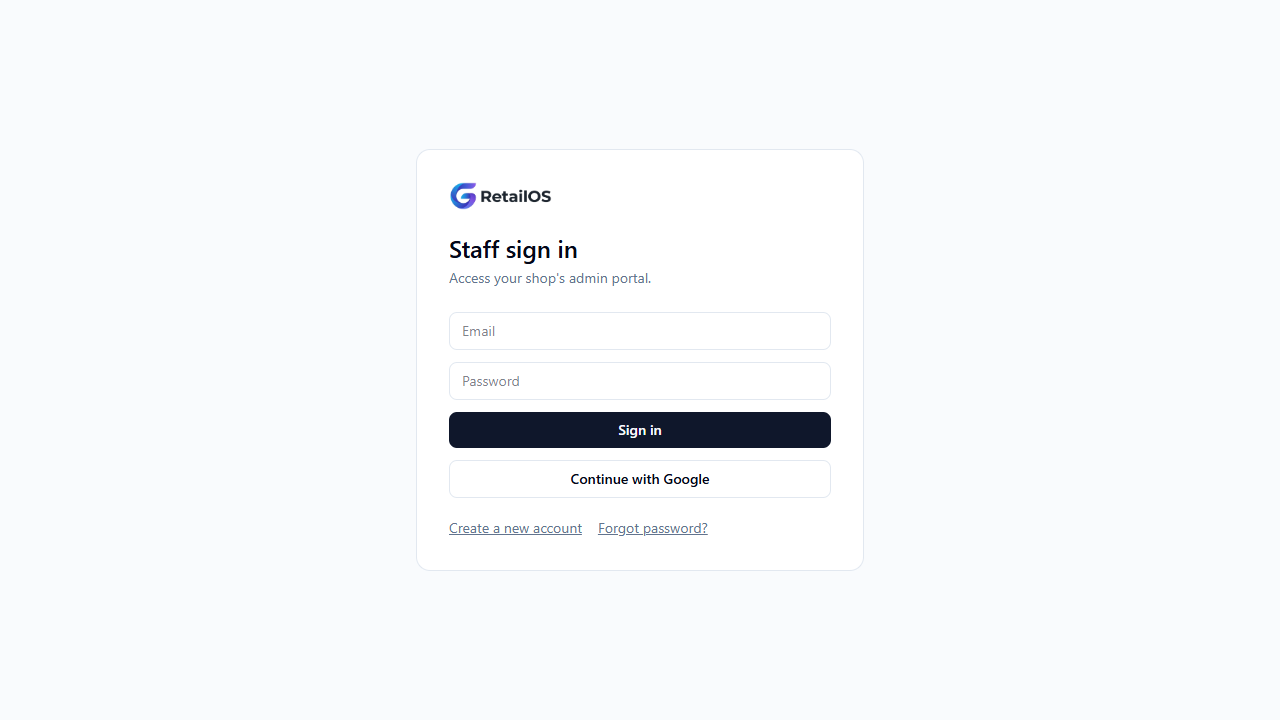
Sign in / Sign up — /auth (?mode=signup)
- Purpose: Staff authentication and new-account registration for the admin portal.
- Access: Public (unauthenticated). Already-signed-in users are redirected to
/admin. - Backend: Supabase Auth client SDK (no server fn / zod) —
supabase.auth.signUp/supabase.auth.signInWithPassword→auth.users(a DB trigger mirrors intoprofiles).mode=signupsearch param preselects the sign-up view.
Fields
| UI label | Field key | Type | Req | Default | Validation / options | Notes |
|---|---|---|---|---|---|---|
| Full name | fullName | text | ● (signup only) | "" | — | Passed as options.data.full_name → user metadata → profiles.full_name. Hidden in sign-in mode. |
| ● | "" | trimmed | Used for both signup and signin | |||
| Password | password | password | ● | "" | Supabase policy (min 6) | — |
| — | mode | search param | — | (signin) | "signup" toggles view | Also toggled by "Create a new account" link |
Connections
- Feeds / used by: Session drives all
_authenticated/*routes;full_name/emailsurface in Team → Members. New signup withemailRedirectTo=/admin. - Cross-form effects: Successful auth navigates to
/admin(which routes to Onboarding if the user has no shop). Signup without a session shows "check your email to confirm."
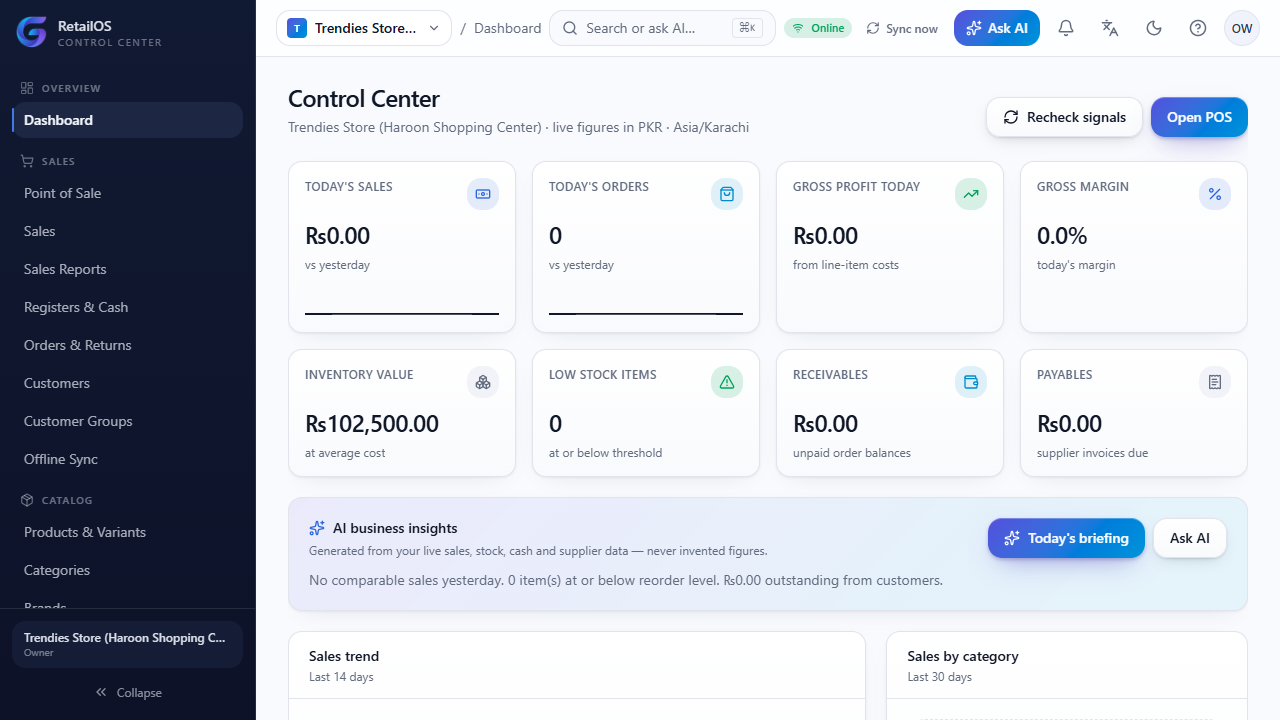
After signing in you land on the admin dashboard (/admin) — KPI cards with trends, a 14-day sales chart, category mix, profitability, AI insights and an alert centre.
Forgot password — /auth (inline action)
- Purpose: Trigger a password-reset email.
- Access: Public (sign-in view only).
- Backend:
supabase.auth.resetPasswordForEmail(email, { redirectTo: /reset-password?next=%2Fadmin })(client SDK).
Fields
| UI label | Field key | Type | Req | Default | Validation / options | Notes |
|---|---|---|---|---|---|---|
| ● | "" | non-empty (reuses the sign-in Email input) | Always shows generic "if that email has an account…" message |
Connections
- Cross-form effects: Email link lands on Reset password with
next=/admin.
Reset password — /reset-password (?next=<relative path>)
- Purpose: Set a new password from a recovery link (used by both staff and storefront customers).
- Access: Public, but the Update button is enabled only once a recovery/
SIGNED_INsession is present. - Backend:
supabase.auth.updateUser({ password })(client SDK) →auth.users.
Fields
| UI label | Field key | Type | Req | Default | Validation / options | Notes |
|---|---|---|---|---|---|---|
| New password | password | password | ● | "" | min 6 chars | — |
| Confirm new password | confirm | password | ● | "" | must equal password | — |
| — | next | search param | — | /admin | must start with / and not // (same-origin only) | Redirect target after success |
Connections
- Cross-form effects: On success redirects to
next(default/admin) after ~1.2s.
Onboarding — create shop — /onboarding (auth-gated)
- Purpose: Provision a new tenant (shop) for the signed-in user, who becomes owner.
- Access: Any authenticated user (creator is inserted as
owner). - Sign out: A Sign out button in the header ends the current session and returns to
/auth— use it if you signed in with the wrong account before creating a shop. - Backend:
createShop(src/lib/shop.functions.ts) →provisionShop(src/lib/shop.server.ts) → tablesshops,shop_users, and many child tables (see cross-form effects).
Fields (authoritative = createShop zod schema)
| UI label | Field key | Type | Req | Default | Validation / options | Notes |
|---|---|---|---|---|---|---|
| Shop name | name | text | ● | "" | 2–80 chars (button disabled < 2) | — |
| Store address (URL slug) | slug | text | ● | auto from name | 2–60 chars; server re-slugifies ([^a-z0-9-]→-) & checks uniqueness | Client defaults to name lowercased-hyphenated |
| Currency | currency_code | select | ● | "USD" | 2–5 chars; USD/PKR/QAR/AED/SAR/INR/EUR/GBP | — |
| — | currency_symbol | text | ● (auto) | "$" | 1–5 chars | auto — derived client-side from selected currency |
| Timezone | timezone | select | ● | "UTC" | UTC/Asia/Karachi/Riyadh/Qatar/Dubai/Kolkata/Europe/London/America/New_York | — |
| Default language | default_locale | select | ● | "en" | enum en/ar/ur/hi | From SUPPORTED_LOCALES |
| Storefront languages | supported_locales | checkbox[] | ● | ["en"] | array of en/ar/ur/hi, min 1 | Falls back to ["en"] if none checked |
| Phone | phone | text | ○ | "" | ≤ 40 chars | — |
| text | ○ | "" | ≤ 120 chars (not validated as email) | — | ||
| Address | address | text | ○ | "" | ≤ 240 chars | — |
| — | created_by | uuid | auto | context.userId | — | Server-set |
| — | settings | jsonb | auto | DEFAULT_SHOP_SETTINGS | — | Large default object (tax/receipt/inventory/pricing/etc.) |
Connections
- Feeds / used by: Creates the tenant consumed by every admin/POS/storefront route; owner membership drives
getMyShopsand the role matrix. - Cross-form effects (all in
provisionShop, one batch of inserts): shops(withsettings = DEFAULT_SHOP_SETTINGS),shop_users(creator →owner)branches: "Main Branch" (MAIN,is_default, default business_hours)registers: "Register 1" (REG1);inventory_locations: "Main Store" (is_default)payment_methods: Cash / Card / Bank Transfer / Store Credit (disabled) / Cash on Deliverytax_rates: "Standard VAT" rate 0 (is_default)accounts: 14-line chart of accounts (is_system)document_sequences: 8 doc types (order/receipt/invoice/purchase_order/return/credit_note/debit_note/goods_receipt)ai_permissions: 19 capability rows;storefront_settings(1 row);storefront_navigation(5);storefront_policies(4);expense_categories(5)
Accept invitation — /invite/$token
- Purpose: Let an invited user join a shop's team.
- Access: Preview is public; accepting requires being signed in with the invited email.
- Backend:
getInvitationPreview(unauth) andacceptStaffInvitation(auth) (src/lib/team.functions.ts) →team.server.ts→ tablesstaff_invitations(read + update) andshop_users(upsert).
Fields
| UI label | Field key | Type | Req | Default | Validation / options | Notes |
|---|---|---|---|---|---|---|
| — | token | URL param | ● | — | ≥ 10 chars | Route param $token |
| (Accept invitation button) | — | action | — | — | requires signed-in email == invite email (case-insensitive) | Disabled/blocked if revoked, accepted, expired, or email mismatch |
Preview returns (read-only, auto): status, expired, role, email, shopName.
Connections
- Selects / references: Resolves shop name via
staff_invitations.shop_id → shops(name). - Cross-form effects on accept: upsert into
shop_users(shop_id,user_id,role,branch_id,is_active=true, onConflictshop_id,user_id); setstaff_invitations.status='accepted',accepted_at,accepted_by; audit log; navigates to/admin.
Invite a staff member — /admin/team
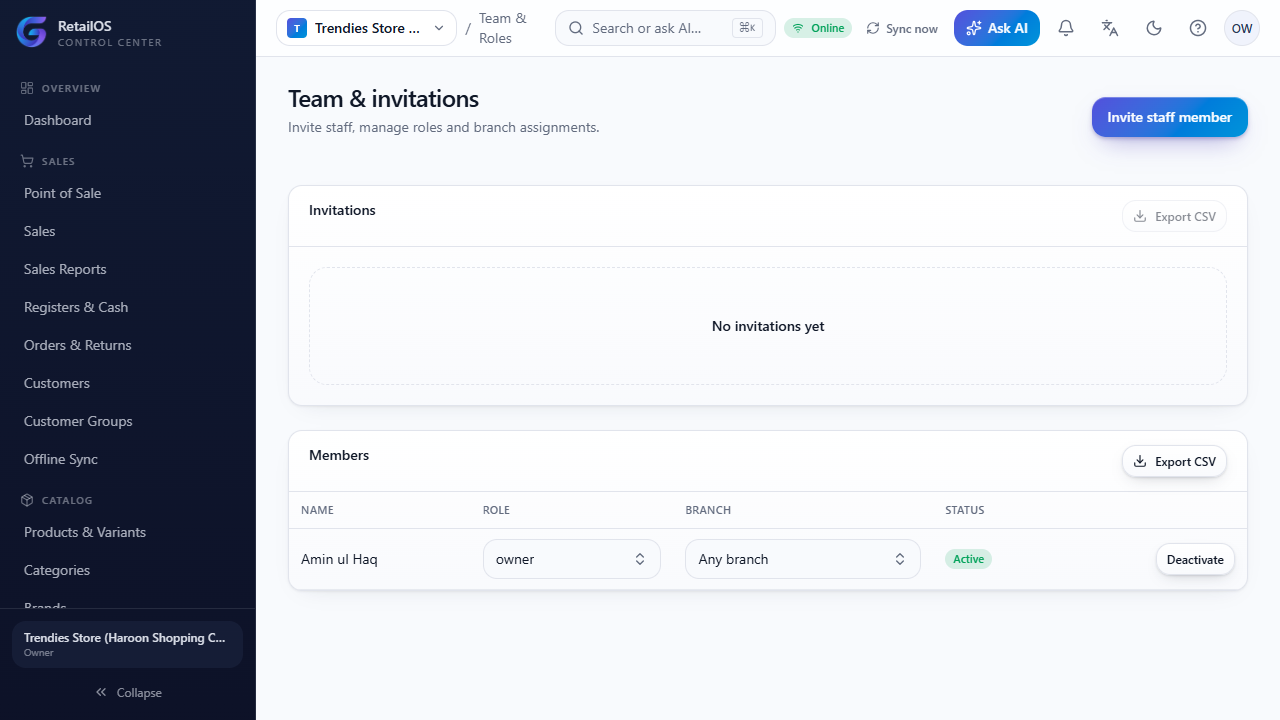
- Purpose: Send a staff invitation and generate a shareable invite link.
- Access:
owner,admin— page requirescan("settings"); server enforcesrequireRole(..., ADMINS). - Backend:
inviteStaffMember(src/lib/team.functions.ts) →inviteStaff(team.server.ts) → tablestaff_invitations.
Fields
| UI label | Field key | Type | Req | Default | Validation / options | Notes |
|---|---|---|---|---|---|---|
| ● | "" | z.string().email(); lowercased on insert | — | |||
| Role | role | select | ● | "staff" | enum owner/admin/manager/cashier/accountant/inventory/staff | — |
| Branch | branchId | select | ○ | "" → null | uuid nullable; "Any branch" = null | Options from Branches (shop-scoped) |
| — | shopId | uuid | auto | active shop | — | From useAdminShop |
| — | origin | url | auto | window.location.origin | — | Used to build invite link |
| — | token | text | auto | gen_random_bytes(24) hex | — | DB-generated |
| — | status | text | auto | "pending" | pending/accepted/revoked/expired | — |
| — | expires_at | timestamptz | auto | now + 14 days | — | — |
| — | invited_by | uuid | auto | context.userId | — | — |
Connections
- Selects / references: Branch (from Branches) via
branch_id. - Feeds / used by: Row appears in Invitations list; link consumed by Accept invitation. Returns
{ link: <origin>/invite/<token> }shown with a Copy button. - Cross-form effects: Insert into
staff_invitations; auditstaff.invite.
Revoke invitation — /admin/team (Invitations list)
- Purpose: Cancel a pending invitation.
- Access:
owner,admin. - Backend:
revokeStaffInvitation→revokeInvitation→staff_invitations(setstatus='revoked').
Fields
| UI label | Field key | Type | Req | Default | Validation / options | Notes |
|---|---|---|---|---|---|---|
| (Revoke button) | invitationId | uuid | ● | — | uuid | Only shown when status='pending' |
| — | shopId | uuid | auto | active shop | — | — |
Edit / deactivate member — /admin/team (Members list)
- Purpose: Change a member's role/branch or (de)activate them.
- Access:
owner,admin. - Backend:
updateTeamMember(src/lib/team.functions.ts) →updateMember(team.server.ts) → tableshop_users.
Fields
| UI label | Field key | Type | Req | Default | Validation / options | Notes |
|---|---|---|---|---|---|---|
| Role (inline select) | role | select | ○ | member's current | enum owner/admin/manager/cashier/accountant/inventory/staff | Saves on change |
| Branch (inline select) | branchId | select | ○ | member's current | uuid nullable; "Any branch"=null | Options from Branches |
| Deactivate / Reactivate | isActive | boolean | ○ | member's current | toggles is_active | Button label flips on state |
| — | memberId | uuid | ● | — | the shop_users.id | — |
| — | shopId | uuid | auto | active shop | — | — |
Connections
- Cross-form effects: Updates
shop_users; auditstaff.member.update. Guard: cannot demote or deactivate the last activeowner("must always have at least one active owner").
Shop Settings — /admin/settings
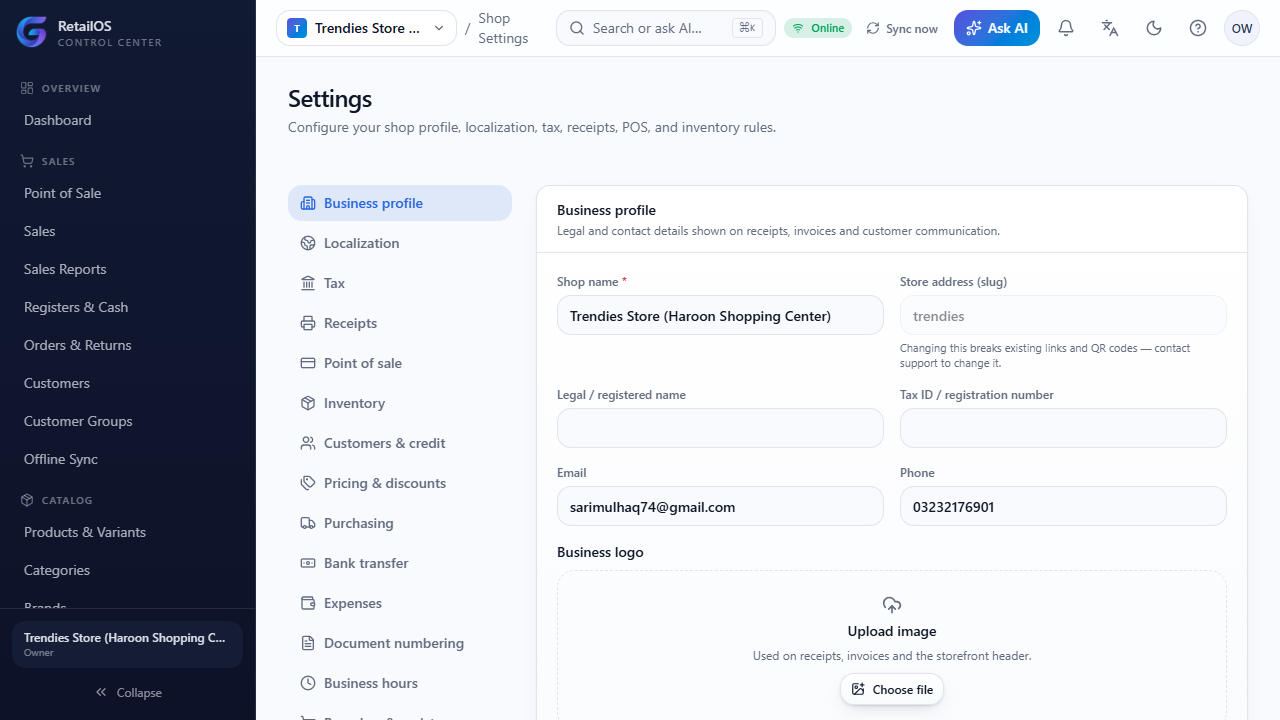
- Backend (all sections except Tax rates & Branches):
updateShopSection(src/lib/shop.functions.ts) writesshopscolumns (theshoppatch) and/or merges intoshops.settings[<section>]jsonb (thesettingsPatch). Section role gate enforced server-side viahas_shop_role; the write uses the service-role client after the check. - Access per section: Business, Localization, Tax, Document numbering, Customers & credit →
owner,admin. Receipts, POS, Inventory, Pricing, Purchasing, Business hours, Notifications →owner,admin,manager. Lower roles see the section read-only.
Business profile — settings section business
Writes shops columns + settings.business.tax_id.
| UI label | Field key | Type | Req | Default | Validation / options | Notes |
|---|---|---|---|---|---|---|
| Shop name | name | text (shop col) | ● | shops.name | trimmed, non-empty | — |
| Store address (slug) | slug | text (shop col) | — | shops.slug | read-only | "Contact support to change" |
| Legal / registered name | legal_name | text (shop col) | ○ | "" → null | — | — |
| Tax ID / registration number | tax_id | text (settings.business) | ○ | "" | — | Only settings-jsonb field here |
| email (shop col) | ○ | "" → null | — | — | ||
| Phone | phone | text (shop col) | ○ | "" → null | — | — |
| Business logo | logo_url | image upload (shop col) | ○ | "" → null | via AdminImageUpload (folder branding) | Used on receipts/invoices/storefront |
| Address | address | textarea (shop col) | ○ | "" → null | — | — |
| Timezone | timezone | text (shop col) | ● | shops.timezone | free-text | — |
Localization — settings section localization (writes shops columns)
| UI label | Field key | Type | Req | Default | Validation / options | Notes |
|---|---|---|---|---|---|---|
| Default language | default_locale | select | ● | shops.default_locale | en/ar/ur/hi | Drives RTL |
| Currency code | currency_code | text | ● | shops.currency_code | uppercased | — |
| Currency symbol | currency_symbol | text | ● | shops.currency_symbol | — | — |
| Symbol position | currency_position | select | ● | before | before / after | — |
| Decimal places | decimal_places | number | ● | 2 | 0–4 | — |
| Decimal separator | decimal_separator | text | ● | "." | — | — |
| Thousand separator | thousand_separator | text | ● | "," | — | — |
| Date format | date_format | text | ● | "dd/MM/yyyy" | — | — |
| Time format | time_format | select | ● | "HH:mm" | 24h / 12h | — |
Tax — settings section tax (+ inline tax_rates editing)
| UI label | Field key | Type | Req | Default | Validation / options | Notes |
|---|---|---|---|---|---|---|
| Tax registered | enabled | toggle | ○ | true | — | — |
| Prices include tax | inclusive | toggle | ○ | false | — | — |
| Tax registration number | registration_number | text | ○ | "" | — | — |
| Rounding rule | rounding | select | ○ | "nearest_0.05" | none / nearest_0.05 / nearest_0.10 / nearest_1 | — |
Tax rates sub-table (writes tax_rates directly): rate (number, saved on blur), is_default (radio — one default).
Receipts — settings section receipt
| UI label | Field key | Type | Req | Default | Validation / options | Notes |
|---|---|---|---|---|---|---|
| Header text | header | textarea | ○ | "" | — | — |
| Footer text | footer | textarea | ○ | "" | — | — |
| Show tax breakdown | show_tax_number | toggle | ○ | true | — | — |
| Show logo on receipt | show_logo | toggle | ○ | true | — | — |
| Roll width | roll_width | select | ○ | "80mm" | 58mm / 80mm | — |
| Reprint policy | reprint_policy | select | ○ | "allowed" | allowed / manager_approval / blocked | — |
Printer (this device only, saved to localStorage — not DB): Printer type (browser / escpos-bridge), Paper width, Bridge URL, Printer name, Auto-cut, Kick cash drawer.
Point of sale — settings section pos
| UI label | Field key | Type | Req | Default | Validation / options | Notes |
|---|---|---|---|---|---|---|
| Default branch | default_branch_id | select | ○ | "" | from Branches | Clears register on change |
| Default register | default_register_id | select | ○ | "" | from Registers filtered by branch | — |
| Allow line-item discounts | allow_line_discounts | toggle | ○ | true | — | — |
| Maximum discount % | max_discount_percent | number | ○ | 20 | 0–100 | Cashier ceiling |
| Require customer on sale | require_customer | toggle | ○ | false | — | — |
| Cash rounding | cash_rounding | select | ○ | "none" | none / nearest_0.05 / nearest_0.10 | — |
| Offline mode | offline_mode_enabled | toggle | ○ | true | — | — |
Inventory — settings section inventory
| UI label | Field key | Type | Req | Default | Validation / options | Notes |
|---|---|---|---|---|---|---|
| Allow negative stock | allow_negative_stock | toggle | ○ | false | — | Shop-wide switch; still governs the online-store checkout |
| Who can oversell (negative stock) | oversell_roles | multi-select (roles) | ○ | owner/admin/manager | role checklist | Only these roles may complete a till sale that drives stock below zero (enforced client- and server-side); owner/admin always included |
| Default location | default_location_id | select | ○ | default location | from Inventory locations | — |
| Low-stock threshold (default) | low_stock_threshold | number | ○ | 5 | ≥ 0 | — |
| Reorder point | reorder_point | number | ○ | 10 | ≥ 0 | — |
| Reorder quantity | reorder_quantity | number | ○ | 20 | ≥ 0 | — |
Delivery charges — settings section delivery
- Purpose: Storefront delivery pricing — a default policy plus optional per-zone overrides resolved exact city → country-wide → default. Charges are computed server-side at checkout and set the order's
shipping_total. Backend:retail.server.ts(resolveDeliveryPolicy/computeDeliveryCharge/deliveryFreeThreshold), read viagetShopDeliverySettings; stored undershops.settings.delivery.
| UI label | Field key | Type | Req | Default | Notes |
|---|---|---|---|---|---|
| Enable delivery | enabled | toggle | ○ | false | off → checkout shows no delivery step |
| Charge mode | charge_mode | select | ○ | flat | flat (one amount) or slabs (tiered by order value) |
| Flat charge | flat_charge | number | ○ (flat) | 0 | delivery fee in flat mode |
| Slabs | slabs[] | rows | ○ (slabs) | — | tiered charge bands by order value |
| Free delivery above | free_delivery_threshold | number | ○ | 0 | orders at/above ship free (0 = never) |
| Zones | zones[] | rows | — | — | per country / city override; blank city = whole country |
| Show free-delivery banner | show_free_delivery_banner | toggle | ○ | true | storefront header banner promoting the free-delivery threshold |
Storefront effect: the checkout country / city selectors pick the matching zone; the header shows the free-delivery banner when enabled and a threshold is set.
Pricing & discounts — settings section pricing
| UI label | Field key | Type | Req | Default | Validation / options | Notes |
|---|---|---|---|---|---|---|
| Default markup % | default_markup_percent | number | ○ | 30 | — | — |
| Price rounding | price_rounding | select | ○ | "none" | none / nearest_0_05 / nearest_0_50 / nearest_1 / charm_99 | — |
| Max line discount % (cashier) | max_line_discount_percent | number | ○ | 10 | — | — |
| Max order discount % (cashier) | max_order_discount_percent | number | ○ | 15 | — | — |
| Require manager approval above limits | require_manager_override | toggle | ○ | true | — | — |
| Allow selling below cost | allow_below_cost | toggle | ○ | false | — | — |
Purchasing — settings section purchasing
| UI label | Field key | Type | Req | Default | Validation / options | Notes |
|---|---|---|---|---|---|---|
| Default supplier payment terms (days) | default_payment_terms_days | number | ○ | 30 | — | — |
| Require approval before sending a PO | require_po_approval | toggle | ○ | true | — | — |
| Approval required above amount | po_approval_threshold | number | ○ | 0 | 0 = every PO needs approval | — |
| Allow receiving more than ordered | allow_over_receipt | toggle | ○ | false | — | — |
| Update item cost on goods receipt | auto_update_cost_on_receipt | toggle | ○ | true | — | — |
| Costing method | costing_method | select | ○ | "weighted_average" | weighted_average / last_cost | — |
Bank transfer — settings section payments
Bank-account details shown to customers who pick bank transfer at online checkout. Owner/admin only.
| UI label | Field key | Type | Req | Default | Notes |
|---|---|---|---|---|---|
| Bank name | bank_name | text | ○ | "" | — |
| Account title | account_title | text | ○ | "" | — |
| Account number | account_number | text | ○ | "" | — |
| IBAN | iban | text | ○ | "" | — |
| Transfer instructions | instructions | textarea | ○ | "" | Shown to customers who choose bank transfer at checkout |
| Payment reference note | reference_note | text | ○ | "" | Optional — e.g. "Use your order number as the reference." |
Connections — surfaced on the storefront checkout when the shopper selects Bank transfer, and on the order confirmation so they can complete the transfer.
Expenses — settings section expenses
Approval policy for expenses recorded in Accounting. Owner/admin only.
| UI label | Field key | Type | Req | Default | Notes |
|---|---|---|---|---|---|
| Require approval before expenses post to the ledger | require_approval | toggle | ○ | false | When off, expenses post immediately (default) |
| Only require approval at or above this amount | approval_threshold | number | ○ | 0 | 0 = every expense needs approval when the toggle is on |
Connections — governs Record expense (/admin/accounting): above-threshold expenses wait for approval before posting to the ledger.
Customers & credit — settings section customers
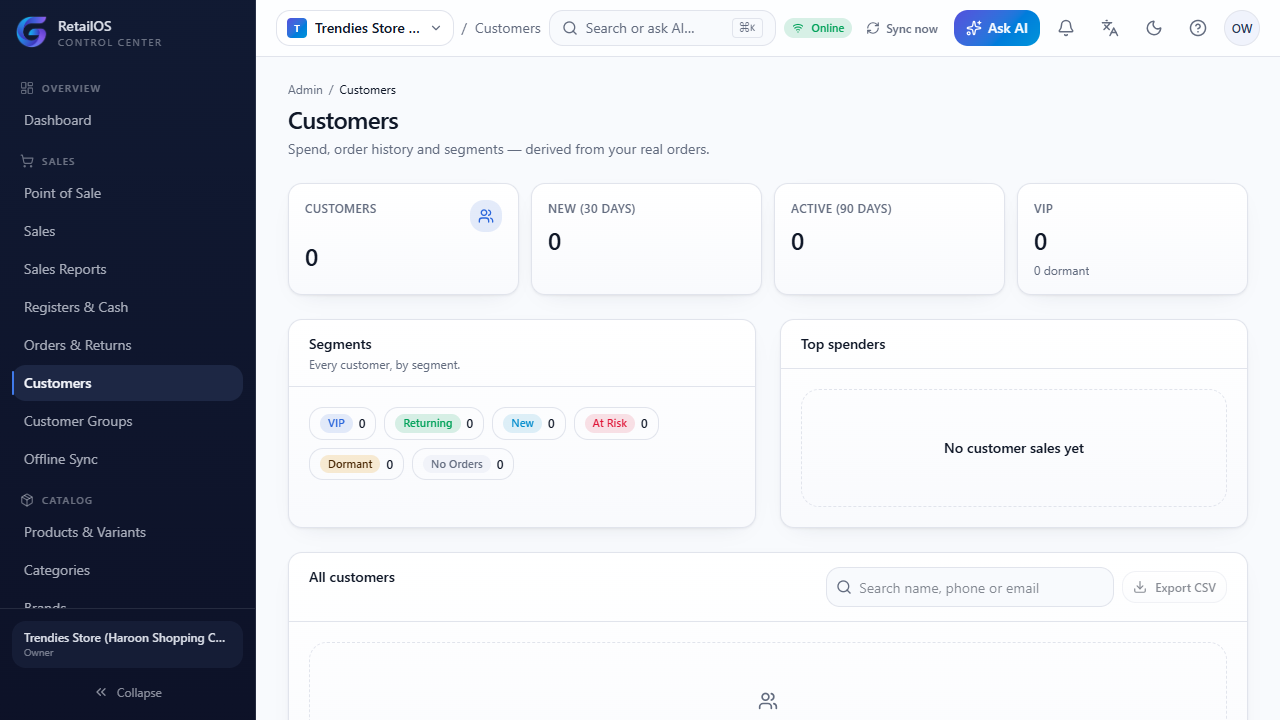
Governs customer accounts and whether staff may sell on credit / udhaar (pay later) at the till. Owner/admin only.
| UI label | Field key | Type | Req | Default | Validation / options | Notes |
|---|---|---|---|---|---|---|
| Allow credit sales (udhaar) | credit_allowed | toggle | ○ | false | — | Master switch; when off the POS credit tender is hidden |
| Default credit limit (suggestion) | default_credit_limit | number | ○ | 0 | ≥ 0 | Pre-fills the limit when creating a customer; 0 = unlimited. Enforcement always uses each customer's own credit_limit |
| Who can sell on credit | credit_roles | multi-select (roles) | ○ | owner/admin/manager | role checklist | Only these roles see and can use the credit tender; owner/admin always included |
Connections — read by the POS Payment screen to decide whether the signed-in user may sell on credit; the unpaid balance of a credit sale posts to the customer's Accounts Receivable and is settled later from Sales → Record payment. See Payment screen → Credit (pay later).
Document numbering — settings section documents
| UI label | Field key | Type | Req | Default | Validation / options | Notes |
|---|---|---|---|---|---|---|
| Sales order prefix | order_prefix | text | ○ | "SO-" | — | — |
| Receipt prefix | receipt_prefix | text | ○ | "RCP-" | — | — |
| Purchase order prefix | purchase_order_prefix | text | ○ | "PO-" | — | — |
| Stock transfer prefix | transfer_prefix | text | ○ | "TR-" | — | — |
| Number padding | number_padding | number | ○ | 5 | 5 → SO-00001 | — |
| Reset sequences each year | reset_yearly | toggle | ○ | false | — | — |
This section writes only toshops.settings.documents. The livedocument_sequencesrows (their ownprefix/padding/next_number) are created at onboarding and are not edited here.
Business hours — settings section hours
Weekday/weekend open & close times (text, e.g. "09:00"), closed days (comma-separated), holiday notice (textarea).
Notifications & alerts — settings section notifications
Low stock alerts, Daily briefing, End-of-day summary — all toggles, default on.
Branches & registers — read-only summary
Read-only overview of branches and registers; "Manage registers →" links to /admin/registers.
Connections (Shop Settings overall)
- Selects / references: POS section → Branches (
default_branch_id) and Registers (default_register_id); Inventory → Inventory locations (default_location_id); Tax → Tax rates. - Feeds / used by:
shops.settingsdrives POS guardrails, pricing/discount limits, purchasing approvals, receipt rendering, storefront hours, and notifications. Business/localization columns render on receipts, invoices, storefront and admin/POS formatting. - Cross-form effects: Business writes
shopscolumns +settings.business.tax_id; other sections merge intoshops.settings[<section>]; Tax-rate edits writetax_ratesdirectly. Writes bypass the owner/admin-onlyshopsRLS via the service-role client after the section role check (so managers can save their permitted sections).
Tables owned: shops (PK id; created_by→auth user; unique slug), profiles (PK id→auth.users), shop_users (shop_id→shops, user_id→auth user, branch_id→branches), staff_invitations (shop_id→shops, branch_id→branches, invited_by/accepted_by→auth users, unique token), branches (shop_id→shops), document_sequences (shop_id→shops, unique (shop_id,doc_type)), storefront_settings (shop_id→shops, unique). Provisioned/referenced: registers, inventory_locations, tax_rates, payment_methods, accounts, ai_permissions, storefront_navigation, storefront_policies, expense_categories, audit_logs (all shop_id→shops).
Store Data Manager — /admin/data-manager
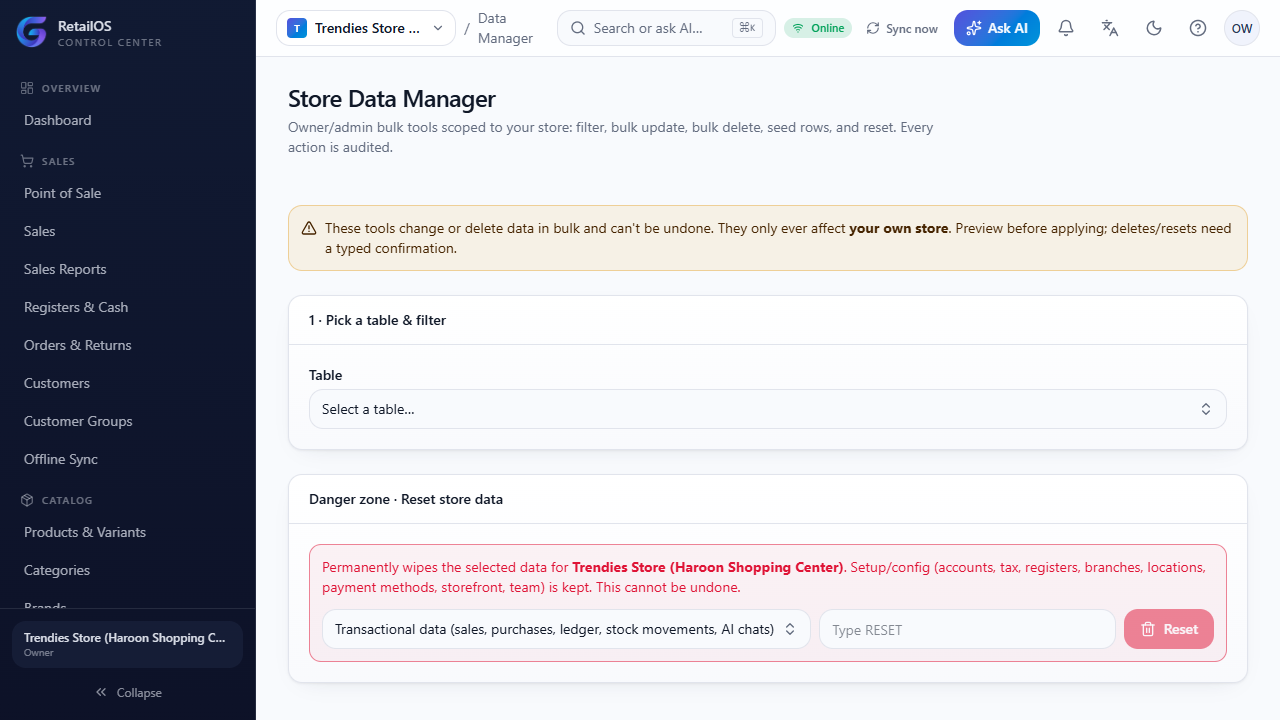
- Purpose: Per-store bulk data tools — filter, bulk-update, bulk-delete, insert/seed and (owner-only) reset any of your store's own tables from one screen, without writing raw SQL.
- Access: owner / admin only; Reset is owner-only. Every action is audited. No schema change / migration — it operates on the existing tenant tables.
- Backend: server functions scoped to the active shop; writes can never reach another shop's rows.
Workflow
- Pick a table — grouped as Catalog, Customers & suppliers, Operations, Sales & finance, Config. A couple (team members, audit log) are view-only for safety.
- Filter — build conditions (column · operator · value); operators include equals / not-equals, greater / less, contains, in (comma list) and is-empty / not-empty, with a Match ALL (AND) / Match ANY (OR) toggle. A compiled query preview shows exactly what will run.
- Preview — returns the matching row count plus a sample of rows before you change anything.
- Bulk update sets one or more columns on every matching row; Bulk delete requires typing
DELETEto confirm. Both re-check the previewed count before applying, are capped at 50,000 rows, and are audited. - Add / seed rows — paste JSON (an array of objects) or CSV (first row = column names);
shop_idis added automatically.
Foreign-key dependency resolver — if a delete is blocked by related records (a foreign key), a popup lists the referencing rows per table with Delete these or Set null (unlink). If clearing one of those is itself blocked, a nested popup opens — resolve down the chain, then delete again.
Reset (owner only) — wipe Transactional, Catalog & CRM, or Everything for the store, keeping setup/config (accounts, tax, registers, branches, locations, payment methods, storefront, team). Type RESET to confirm; a blocked reset offers the same dependency resolver.
Safety model: owner/admin only (Reset owner-only) · own-store only (always shop_id-scoped) · no raw SQL · typed confirmations (DELETE / RESET) · a 50,000-row cap · protected read-only tables (team members, audit log) · every action audited.
Subscription & usage — /admin/subscription
- Purpose: Your free trial, per-module licenses, commercial plan and resource consumption in one place. Backend:
getShopResourceUsageFn(usage.functions.ts) + the SaaS plan/billing functions. - Usage tab — Resource usage: how much your store has consumed vs what remains, per category: File storage (product images, payment proofs, HR documents — enforced), Database (records across products, orders, customers, stock), AI (assistant messages, last 30 days), Network (data sent/received through the app in the last 30 days — uploads and storefront media; CDN-cached traffic isn't counted), Team members (enforced when your plan sets a limit), Monthly active users (staff + customer accounts that signed in during the last 30 days — informational, sign-ins are never blocked) and Customers.
- Limits: Your plan's numbers are real for three things — file storage (uploads stop with a clear "Storage limit reached" message at the cap, and a server-side storage policy is the hard backstop so the cap can't be bypassed), team members (inviting, accepting an invite or reactivating someone over the plan's user limit is refused with "You've reached your plan limit…") and AI knowledge documents. The remaining plan quotas in the table below stay informational. Any active license lifts the free-trial caps; the platform team can set individual allowances above your plan — contact support.
- Need more? Limits are adjustable per store: the platform team can set individual overrides (e.g. a larger storage allowance as part of your agreement) from the operator console — contact support. The Usage tab always shows the limits that actually apply to your store.
- Module licenses & access: Access to each of the 14 modules is governed by the Module licenses panel (managed by the platform/operator team, not editable by the shop). On a new store an active free trial covers every module; afterwards each module needs an active license (recorded when payment is received out-of-band). Month grants stack from the current period end; a custom end date cannot shorten an active license (it must be revoked first); a Lifetime grant never expires and absorbs later grants. Hard enforcement follows the platform's
LICENSING_ENFORCEDrollout flag — while it is off (the current default), licensing is informational and never blocks operational functionality. Note: holding any active module license moves the store from the Trial tier to the Licensed tier, which also raises the enforced resource caps (e.g. file storage from the trial 500 MB to the licensed allowance).
Catalog
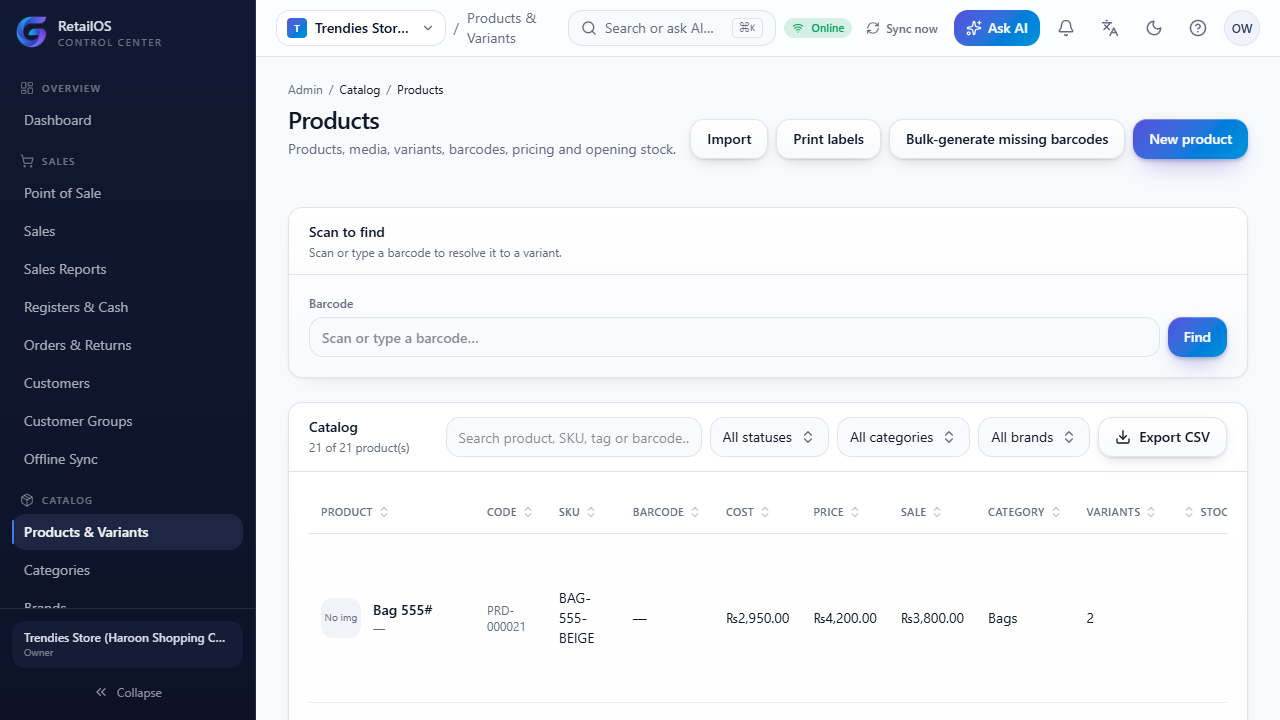
Available for sale (hide internal items). Products, categories and brands each carry an Available for sale toggle (is_online, default on). Turn it off to make an item internal-only — e.g. raw materials, packing supplies, or a supplier-only brand/category: it is hidden from both the online storefront and POS product search, while staying fully usable in inventory, purchasing and the admin catalog. This is separate from Active (the archive flag): Active off = archived everywhere (also removed from POS and product selectors); Available for sale off = kept internally but not sold. Because the default is on, existing items are unaffected until you switch it off.
New / Edit Product — /admin/products
- Purpose: Create or edit a catalog product with its media, merchandising flags, tax default and full variant matrix.
- Access: owner, admin, manager (server
requireRole(..., MANAGERS)). Page requires auth; save is role-gated. - Backend:
saveProductFn(src/lib/catalog.functions.ts) →saveProduct(src/lib/catalog.server.ts) →products(+ cascades toproduct_variants,variant_costs,prices,barcodes,inventory_movements,inventory_balances). Images viasaveProductImagesFn→product_images.
Fields (product level)
| UI label | Field key | Type | Req | Default | Validation / options | Notes |
|---|---|---|---|---|---|---|
| — | shopId | uuid | Yes | active shop | — | auto |
| — | productId | uuid | No | null | — | auto; edit only |
| Product name | name | text | Yes | — | 1–200 chars | drives slug + SKU seed |
| Category | category_id | uuid (select) | No | null | EntitySelect categories | FK → categories |
| Brand | brand_id | uuid (select) | No | null | EntitySelect brands | FK → brands |
| Selling unit | unit | text | No | pcs | max 24 | server falls back to pcs |
| Status | status | enum | Yes | active (UI) | active / draft | DB column default draft |
| Short description | short_description | text | No | null | max 500 | — |
| Full description | description | textarea | No | null | max 20000 | — |
| Tags | tags | string[] | No | [] | ≤30 tags, each 1–40 | comma-separated input |
| Tax rate | tax_rate_id | uuid (select) | No | null | EntitySelect tax_rates | resolves variant→product→category→shop default |
| Available for sale | is_online | boolean | No | true | — | OFF = internal-only — hidden from storefront and POS search; still usable in inventory/purchasing. Separate from Status (archive) |
| Featured | is_featured | boolean | No | false | — | merchandising flag |
| New arrival | is_new_arrival | boolean | No | false | — | — |
| Best seller | is_best_seller | boolean | No | false | — | — |
| — | slug | text | — | slugify(name) | unique per shop | auto on create only |
| — | has_variants | boolean | — | variants.length>1 | — | auto computed |
| Media | (images) | sub-form | No | — | ≤30 images | see Product Images |
| Variants | variants | sub-form | Yes | — | min 1 | see Variant Builder |
Variant Builder sub-form (src/components/admin/VariantBuilder.tsx)
| UI label | Field key | Type | Req | Default | Validation / options | Notes / target |
|---|---|---|---|---|---|---|
| — | id | uuid | No | null | — | auto; edit only |
| Variant | name | text | No | null | max 120 | auto = attribute combo label ("Black / M") |
| SKU | sku | text | Yes | <BASE>-<suffix> | 1–80; unique per shop; no in-product dupes | auto-seeded → product_variants.sku |
| Barcode | barcode | text | No | null | max 64; unique per shop | → barcodes (is_primary); "Gen" button generates |
| Cost | cost | number | No | 0 | 0–10,000,000 | → variant_costs.cost_price & avg_cost (never public) |
| Price | price | number | No | 0 | 0–10,000,000 | → product_variants.price |
| Sale price | sale_price | number | No | null | 0–10,000,000 | >0 → prices (type='sale'); ≤0/empty deactivates |
| Weight | weight | number | No | null | 0–1,000,000 | → product_variants.weight |
| Tax | tax_rate_id | uuid (select) | No | null | tax rate list | collected + bulk-appliable but not persisted per-variant |
| Opening stock | opening_stock | number | No | 0 | 0–10,000,000 | create-only → inventory_movements (opening) + inventory_balances + a balanced GL journal (Dr Inventory 1200 / Cr Owner Equity 3000) for its value |
| Active | is_active | boolean | Yes | true | — | → product_variants.is_active |
| — | attributes | record<string,string> | — | {} | from attribute matrix | → product_variants.attributes (jsonb) |
| — | is_default | boolean | — | index===0 | — | auto; first variant is default |
Attribute matrix: the attribute-name field is a creatable combobox — choose an existing attribute (EntitySelect attributes), or type a new name and press Enter to create it inline (ensureAttributeFn → product_attributes + product_attribute_values); then tick its values → Generate variants builds the cartesian product. A bulk-apply bar sets price/cost/sale_price/weight/opening_stock/tax_rate_id/is_active across all or selected rows.
Number fields select-on-focus. Numeric inputs in the builder (cost, price, sale price, weight, opening stock) select their existing value when you click into them, so typing cleanly replaces a leading "0".
Opening stock posts to the ledger. Entering opening stock with a cost sets on-hand quantity and average cost and books a balanced journal entry Dr Inventory (1200) / Cr Owner Equity (3000) for the opening value (Σ opening_stock × cost) when the product is created, so the GL inventory asset matches the operational balance. Posting is best-effort — if the shop's chart of accounts lacks those accounts or the target period is closed, the stock still saves and the journal is skipped. (Changing a product's stock later via the editor posts a quantity adjustment only, with no journal — matching manual stock adjustments; value inventory changes through a Purchase order → Supplier invoice or an opening-balance journal.)
Product Images sub-form (saveProductImagesFn)
| UI label | Field key | Type | Req | Default | Validation / options | Notes |
|---|---|---|---|---|---|---|
| (upload) | url | text | Yes | — | 1–1000 chars | public URL (bucket product-images) |
| — | storage_path | text | No | null | max 400 | storage key |
| Alt | alt | text | No | null | max 200 | — |
| — | id | uuid | No | null | — | auto on existing rows |
| — | position | int | — | array index | — | auto; index 0 = cover |
Connections
- Selects / references: Category (
category_id), Brand (brand_id), Tax rate (tax_rate_id), Attributes (product_attributes/product_attribute_values). - Feeds / used by: POS (barcode lookup, sale lines; internal-only
is_online=falseitems are excluded from POS product search), Storefront (status=active and available-for-sale), Inventory (balances/movements), Purchasing, Labels. - Cross-form effects: opening stock →
inventory_movements(opening)+inventory_balances+journal_entries(Dr Inventory 1200 / Cr Owner Equity 3000); cost →variant_costs(private); price →product_variants.price(firespricing_versiontrigger); sale price →prices; barcode →barcodes.
Save errors show the real reason. When a save or submit fails — here or anywhere else in the admin — the message now names the actual cause (e.g. a duplicate SKU, a validation problem, or a permission block) instead of a generic "Could not save…".
Barcode generate / attach — /admin/products (variant panel + builder "Gen")
- Purpose: Generate or manually attach EAN-13 / CODE128 barcodes to a variant; deactivate old ones.
- Access: panel (generate/attach/deactivate) = owner, admin, manager, inventory; builder "Gen" & bulk-generate = owner, admin, manager.
- Backend: panel →
generateBarcodeFn/attachBarcodeFn/deactivateBarcodeFn/listVariantBarcodesFn(src/lib/barcode.functions.ts); builder/bulk →generateBarcodeFn/bulkGenerateBarcodesFn(src/lib/catalog.functions.ts). Both →barcodes.
| UI label | Field key | Type | Req | Default | Validation / options | Notes |
|---|---|---|---|---|---|---|
| — | shopId | uuid | Yes | active shop | — | auto |
| — | variantId | uuid | Yes | — | — | target variant |
| (Generate EAN-13 / CODE128) | type | enum | Yes | ean13 | ean13 / code128 | — |
| Attach manual barcode | code | text | Yes (attach) | — | 1–64; EAN-13 needs valid GS1 check digit; CODE128 ≤48 | duplicate active code rejected |
| — | (check digit) | — | auto | — | GS1 mod-10 (ean13CheckDigit) | auto |
| — | source | text | auto | generated / manual | — | auto per path |
| — | is_primary | boolean | auto | true if first active | — | deactivate promotes next barcode |
| — | is_active | boolean | auto | true | — | soft-delete keeps history |
Generation uniqueness: barcode.server uses a shop-scoped sequence (ean13FromSequence, prefix 20); catalog.server uses random makeEan13 (prefix 200). "Bulk-generate missing" issues EAN-13 for every variant lacking one. Scan to find (Products page): lookupBarcodeFn resolves an active code to variant+product for search/POS.
Category create / edit — /admin/categories
- Purpose: Manage hierarchical catalog categories (menu, category pages, product grouping).
- Access: UI
permission="products"; server write INVENTORY_ROLES. - Backend:
saveMasterDataFn(entitycategories) →categories.
| UI label | Field key | Type | Req | Default | Validation / options | Notes |
|---|---|---|---|---|---|---|
| Name | name | text | Yes | — | required | — |
| Parent category | parent_id | uuid (entity) | No | null | EntitySelect categories; not self | FK → categories |
| Slug | slug | text | No | slugify(name) | unique per shop | auto when blank; dedup-suffixed |
| Display order | position | number | No | 0 | int | sort order |
| Default tax rate | tax_rate_id | uuid (entity) | No | null | EntitySelect tax_rates | category-level tax fallback |
| Category image | image_url | image | No | null | upload folder categories | — |
| Description | description | textarea | No | null | — | — |
| Available for sale | is_online | boolean | No | true | — | OFF = internal-only category — hidden from storefront and POS; still usable in inventory/purchasing |
| Visible on storefront | is_active | boolean | No | true | — | archive toggle |
Connections — self parent_id; tax_rate_id→tax_rates; used by products (category_id), storefront menu/category pages, filters. Delete blocked while referenced by products or child categories (archive instead).
Brand create / edit — /admin/brands
- Access: UI
permission="products"; server write INVENTORY_ROLES. Backend:saveMasterDataFn(entitybrands) →brands.
| UI label | Field key | Type | Req | Default | Validation / options | Notes |
|---|---|---|---|---|---|---|
| Name | name | text | Yes | — | required | — |
| Slug | slug | text | No | slugify(name) | unique per shop | auto when blank |
| Brand logo | logo_url | image | No | null | folder brands | — |
| Description | description | textarea | No | null | — | — |
| Available for sale | is_online | boolean | No | true | — | OFF = internal-only brand — hidden from storefront and POS; still usable in inventory/purchasing |
| Visible on storefront | is_active | boolean | No | true | — | archive toggle |
Connections — used by products (brand_id), storefront brand filters/pages. Delete blocked while products reference it.
Attribute + values — /admin/attributes
- Purpose: Define variant attributes (Size, Colour…) and allowed values; feed the variant matrix.
- Access: UI
permission="products"; server write INVENTORY_ROLES. - Backend: attributes →
saveMasterDataFn(entityattributes) →product_attributes; values →saveMasterDataFn(entityattribute_values) →product_attribute_values. The variant builder's attribute-name field is a creatable combobox that adds new attributes inline viaensureAttributeFn.
Attribute
| UI label | Field key | Type | Req | Default | Validation / options | Notes |
|---|---|---|---|---|---|---|
| Attribute name | name | text | Yes | — | required | — |
| Code | code | text | No | slugify(name) | unique per shop | auto when blank |
Attribute value sub-form
| UI label | Field key | Type | Req | Default | Validation / options | Notes |
|---|---|---|---|---|---|---|
| Value | value | text | Yes | — | required | — |
| — | attribute_id | uuid | Yes | selected attribute | — | auto from panel scope |
Connections — value attribute_id→product_attributes; feeds VariantBuilder → product_variants.attributes. Attribute delete blocked while it has values.
Tax rate create / edit — /admin/tax
- Access: UI
permission="settings"(owner, admin); server write MANAGERS (manager can write via API though UI hides it). - Backend:
saveMasterDataFn(entitytax_rates) →tax_rates.
| UI label | Field key | Type | Req | Default | Validation / options | Notes |
|---|---|---|---|---|---|---|
| Name | name | text | Yes | — | required | placeholder "VAT 15%" |
| Rate (%) | rate | number | Yes | 0 | numeric(6,3); step 0.001 | — |
| Prices include this tax | is_inclusive | boolean | No | false | — | — |
| Use as shop default | is_default | boolean | No | false | exclusive | auto unsets other defaults |
| Active | is_active | boolean | No | true | — | archive toggle |
Connections — used by products, categories, and variant/line tax resolution across POS & online; fires tax_version trigger. Delete blocked while referenced by products, categories or sold order lines; default must be reassigned before delete.
Barcode labels print — /admin/labels
- Purpose: Select variants, pick a size/fields, print a barcode label sheet (no DB writes).
- Access: any authenticated shop member (reads only).
- Backend:
labelCatalogFn(src/lib/catalog.functions.ts) readsproduct_variants(+products,barcodes); render viaBarcodeLabel(JsBarcode).
| UI label | Field key | Type | Req | Default | Validation / options | Notes |
|---|---|---|---|---|---|---|
| (variant select) | selected | checkbox set | — | none | per variant | drives label queue |
| Copies | copies[id] | number | No | 1 | min 1 | per selected variant |
| Label size | sizeId | enum | Yes | 40x30 | 40x30, 50x25, 58roll, a4-3x8, a4-4x10 | mm dims from LABEL_SIZES |
| Show → shop name/logo | fields.shop | boolean | No | true | — | — |
| Show → product name | fields.productName | boolean | No | true | — | — |
| Show → variant | fields.variantName | boolean | No | true | — | — |
| Show → SKU | fields.sku | boolean | No | true | — | — |
| Show → price | fields.price | boolean | No | true | — | — |
| Show → barcode | fields.barcode | boolean | No | true | — | format auto-resolved (EAN13/CODE128) |
Connections — reads primary barcodes.code, variant price/sku, product name, shop name/logo; output goes to window.print only.
Bulk import — /admin/import
- Purpose: Import products / suppliers / inventory from CSV or XLSX: upload → map columns → validate → commit.
- Access: owner, admin, manager (validate & commit).
- Backend:
validateImportFn/commitImportFn(src/lib/import.functions.ts). Products commit →products,product_variants,variant_costs,prices,barcodes,inventory_movements,inventory_balances. - Published on commit: new products are created live —
status = activeandis_online = true— so they show on the storefront, restaurant menu and POS immediately (like manually-created products). Re-importing an existing product (matched by slug/SKU) updates it and leaves its current published state untouched.
Wizard controls
| UI label | Field key | Type | Req | Default | Validation / options | Notes |
|---|---|---|---|---|---|---|
| Type | kind | enum | Yes | products | products / suppliers / inventory | step 1 |
| File | (upload) | file | Yes | — | .csv, .xlsx, .xls; ≤5000 rows | parsed client-side |
| Column mapping | mapping | record | — | auto-guessed | file header → target field | per-field select |
Products import target fields
| UI label | Field key | Req | Validation / options | Notes / target |
|---|---|---|---|---|
| Product name | product_name | Yes | non-empty | groups rows into one product; slug-matched for upsert |
| SKU | sku | Yes | non-empty; dedup in file; existing → update | → product_variants.sku |
| Variant label | variant | No | — | → product_variants.name |
| Attributes | attributes | No | Color:Red;Size:M | parsed → jsonb attributes |
| Category | category | No | matched by name (warns if not found) | → category_id |
| Brand | brand | No | matched by name (warns if not found) | → brand_id |
| Cost | cost | No | numeric, default 0 | → variant_costs |
| Price | price | Yes | numeric | → product_variants.price |
| Sale price | sale_price | No | numeric | → prices (sale) |
| Opening stock | opening_stock | No | numeric, default 0 | new variants only → movements+balances + one GL journal (Dr Inventory 1200 / Cr Owner Equity 3000) for the imported opening value |
| Barcode | barcode | No | dedup in file; cross-product clash = error | → barcodes |
(Suppliers import → suppliers; Inventory import → inventory_*.) Validate cross-checks existing categories, brands, variant SKUs and barcodes, returning per-row ok/warning/error counts. Commit skips error rows, imports ok+warning, audit-logged; products grouped by name → one product with N variants.
Tables owned: products (category_id→categories, brand_id→brands, tax_rate_id→tax_rates; unique shop_id+slug), product_variants (product_id→products; unique shop_id+sku; extra DB cols not in UI: compare_at_price, track_inventory, low_stock_threshold, reorder_point, reorder_quantity), product_attributes (unique shop_id+code), product_attribute_values (attribute_id→product_attributes), product_images (product_id→products, variant_id→product_variants), prices (variant_id→product_variants; price_type='sale'), variant_costs (variant_id→product_variants; private cost), barcodes (variant_id→product_variants; unique shop_id+code, partial-unique on active; type/source/is_primary/is_active), categories (self-FK parent_id, tax_rate_id; unique shop_id+slug), brands (unique shop_id+slug), tax_rates (is_default exclusive). Import also touches inventory_movements/inventory_balances and suppliers.
Inventory
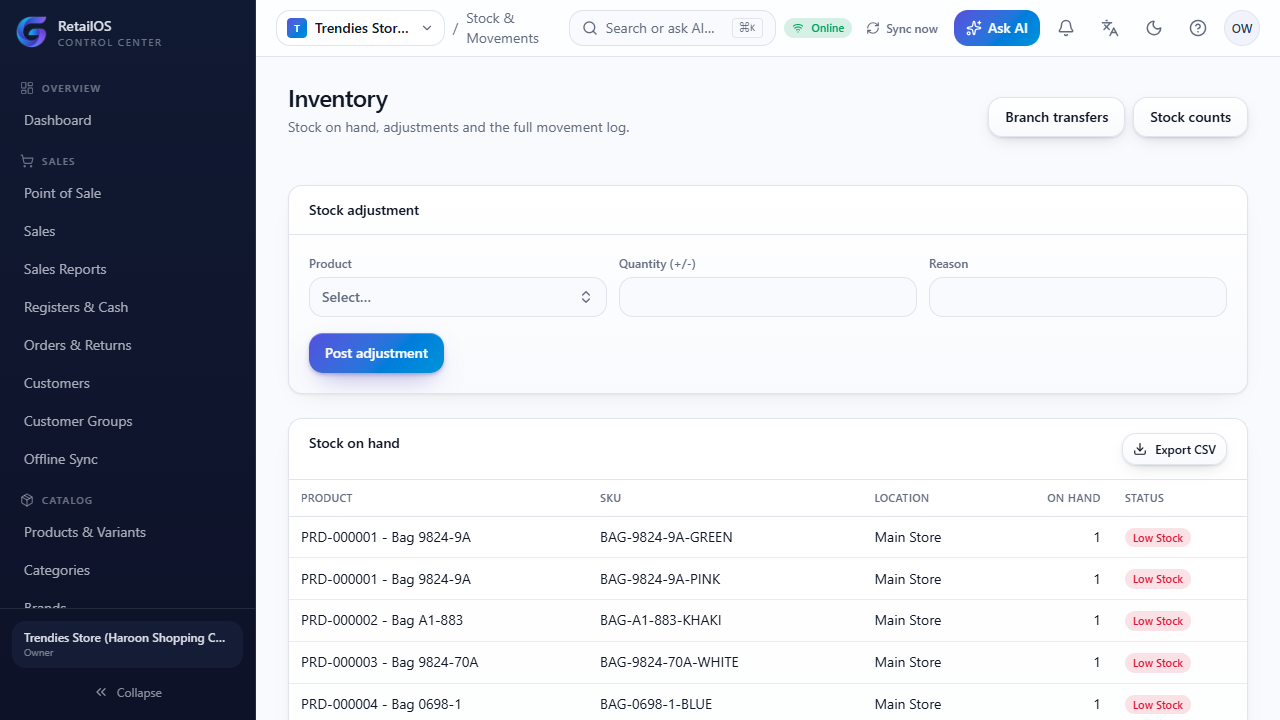
Manual stock adjustment — /admin/inventory
- Purpose: Post a signed (+/-) quantity correction against a variant at the shop's default location, with a reason.
- Access: Route is admin-authenticated; the write is a client-side Supabase insert/update governed by
inventory_movements/inventory_balancesRLS (inventory roles). See role matrix. - Backend: inline
applyAdjustmentin the route → direct writes toinventory_movements+inventory_balances.
Fields
| UI label | Field key | Type | Req | Default | Validation / options | Notes |
|---|---|---|---|---|---|---|
| Product | variant_id | select (uuid) | Yes | "" | variants that already have a balance row | → movement + balance variant_id |
| Quantity (+/-) | quantity | text→number | Yes | "" | Number(quantity) must be non-zero; signed | positive adds, negative removes |
| Reason | note | text | No | "" | — | → inventory_movements.note |
| Location | location_id | — | auto | shop's is_default location | limit 1 | "No inventory location configured" if none |
| Movement type | movement_type | — | auto | 'adjustment' | enum | fixed |
| On-hand after | balance quantity | — | auto | existing + delta | running balance | upserts inventory_balances |
Connections
- Selects / references: Variant via
variant_id; Location implicit via defaultlocation_id. - Feeds / used by: updated balance read by POS / Products / Dashboard low-stock; movement shown in "Recent movements".
- Cross-form effects: each post writes one
inventory_movementsrow and updates/creates theinventory_balancesrow.
Reorder / stock defaults — /admin/settings (Inventory section)
- Purpose: Shop-wide stock defaults (low-stock threshold, reorder point/quantity, default location, negative-stock rule).
- Access: see role matrix (settings-section gate).
- Backend:
updateShopSection(src/lib/shop.functions.ts) →shops.settings.inventory.
| UI label | Field key | Type | Req | Default | Validation / options | Notes |
|---|---|---|---|---|---|---|
| Allow negative stock | allow_negative_stock | toggle | No | false | — | lets sales pass below zero (and governs the online-store checkout) |
| Who can oversell (negative stock) | oversell_roles | multi-select (roles) | No | owner/admin/manager | role checklist | roles allowed to push a till sale below zero; others are capped at on-hand (owner/admin always included) |
| Default location | default_location_id | select | No | default location | active inventory_locations | "No default" allowed |
| Low-stock threshold (default) | low_stock_threshold | number | No | 5 | ≥ 0 | fallback when variant has none |
| Reorder point | reorder_point | number | No | 10 | ≥ 0 | used by AI reorder insights |
| Reorder quantity | reorder_quantity | number | No | 20 | ≥ 0 | suggested order size |
Per-variant overrides (low_stock_threshold, reorder_point, reorder_quantity) exist on product_variants but are not editable in the current UI. These feed AI reorder recommendations and Dashboard "Low stock priority" (variant value ?? default).
Create transfer (draft → send → receive) — /admin/transfers
- Purpose: Move stock between two locations through draft → requested → approved → shipped → received.
- Access: create/edit/ship/receive = INVENTORY_ROLES (owner, admin, manager, inventory); approve = MANAGERS. Cancel disabled once shipped.
- Backend:
createTransferFn,updateTransferItemsFn,transitionTransferFn(src/lib/inventory-ops.functions.ts) →inventory_transfers,inventory_transfer_items; on ship/receive →postInventory(inventory_movements+inventory_balances).
Header fields
| UI label | Field key | Type | Req | Default | Validation / options | Notes |
|---|---|---|---|---|---|---|
| From location | from_location_id | select | Yes | "" | active locations; must differ from To | — |
| To location | to_location_id | select | Yes | "" | active locations, excludes From | — |
| Notes | notes | text | No | — | max 500 | — |
Line items (transferItemSchema)
| UI label | Field key | Type | Req | Default | Validation / options | Notes |
|---|---|---|---|---|---|---|
| Product | variant_id | select | Yes | "" | active variants (limit 500) | — |
| Qty | quantity | number | Yes | "" | 0.001–999999; rows ≤0 dropped; ≥1 line required | — |
| Avail | (computed) | — | auto | — | balance.quantity − reserved at From | display-only guide |
| Unit cost | unit_cost | number | No | 0 | 0–999999 | in schema/server; not in create UI |
Auto/computed record fields: transfer_number (nextDocNumber(..., "transfer", "TR-"), unique per shop), status (default draft; enum draft/requested/approved/shipped/received/cancelled), created_by, per-transition *_by/*_at stamps, and per-line received_quantity (default 0, set at receipt, editable). The Receive step sends receivedQuantities keyed by transfer-item id; Ship validates source availability.
Connections
- Selects / references: From/To via
from_location_id/to_location_id; lines viavariant_id. - Feeds / used by: Ship posts
transfer_out(−) at source; Receive poststransfer_in(+) at destination — both writeinventory_movements+inventory_balances; audittransfer.<status>. - Cross-form effects: stock only leaves source on ship and only lands at destination on receive; draft/requested/approved move no stock.
Stock count (start → count → review → post) — /admin/stock-counts
- Purpose: Physical count vs expected, then post variance adjustments to balances.
- Access: create/save = INVENTORY_ROLES; approve = MANAGERS.
- Backend:
createStockCountFn,saveStockCountProgressFn,approveStockCountFn(src/lib/inventory-ops.functions.ts) →stock_counts,stock_count_items; approve →postInventory.
Create fields
| UI label | Field key | Type | Req | Default | Validation / options | Notes |
|---|---|---|---|---|---|---|
| Location | location_id | select | Yes | "" | active locations | sets expected snapshot source |
| Scope | mode (UI only) | select | Yes | "all" | all / category | maps to fields below |
| — (all) | all_products | boolean | — | true when scope=all | — | seeds every variant |
| Category checkboxes | category_ids | uuid[] | cond. | [] | shown when scope=category | seeds variants of those categories |
| Note | note | text | No | — | max 500 | — |
| — | variant_ids | uuid[] | No | — | in schema, not in UI | explicit variant seed |
Count-sheet line items (stock_count_items)
| UI label | Field key | Type | Req | Default | Validation / options | Notes |
|---|---|---|---|---|---|---|
| Product | variant_id | — | auto | seeded at create | — | — |
| Expected | expected_qty | numeric(14,3) | auto | balance at creation | — | snapshot, not editable |
| Counted | counted_qty | number | Yes | 0 | ≥ 0 | editable until completed |
| Difference | (computed) | — | auto | counted − expected | — | highlighted if ≠ 0 |
Save progress sets status='counting', counted_by. Approve/post posts a count-type movement for every non-zero diff (qty = counted − expected), sets status='completed', approved_by, approved_at, completed_at. It then values the net variance at each variant's cost (variant_costs.avg_cost, else cost_price) and posts one balanced GL journal so the perpetual Inventory account tracks the reconciliation: shrinkage (stock down) posts Dr COGS 5000 / Cr Inventory 1200, overage (stock up) posts Dr Inventory 1200 / Cr COGS 5000. Period-guarded and best-effort — balances are the source of truth and are never rolled back if the chart of accounts lacks 1200/5000 or the period is closed.
Connections
- Selects / references: Location via
location_id; items viavariant_id; scope via categories. - Feeds / used by: approved variances update
inventory_balances; a balancedjournal_entries/journal_entry_linespair (reference_type='stock_count') values the net variance to Inventory 1200 vs COGS 5000; auditstock_count.approved. - Cross-form effects: posting a count writes
inventory_movements(typecount) + updatesinventory_balancesfor each non-zero variance, and mirrors the net cost change to the ledger so the balance sheet Inventory line and P&L stay correct.
Location create / edit — /admin/locations
- Purpose: Manage stock locations that hold balances and receive transfers/counts.
- Access: UI permission
inventory; server write = INVENTORY_ROLES. - Backend:
saveMasterDataFn/setMasterDataActiveFn/deleteMasterDataFn(src/lib/masterdata.functions.ts, entityinventory_locations) →inventory_locations.
| UI label | Field key | Type | Req | Default | Validation / options | Notes |
|---|---|---|---|---|---|---|
| Location name | name | text | Yes | — | placeholder "Main store" | — |
| Branch | branch_id | entity select | No | null | references branches | FK, nullable |
| Default location for sales | is_default | boolean | No | false | — | — |
| Active | is_active | boolean | No | true | — | archivable |
Connections — references Branch via branch_id; owns the inventory_balances/inventory_movements rows; supplies location options to transfers, counts, adjustments, and the settings default location.
Branch create / edit — /admin/branches
- Purpose: Physical trading locations scoping staff, registers, stock locations and reporting.
- Access: UI permission
settings; server write = ADMINS (owner, admin). - Backend:
saveMasterDataFn/setMasterDataActiveFn/deleteMasterDataFn(entitybranches) →branches.
| UI label | Field key | Type | Req | Default | Validation / options | Notes |
|---|---|---|---|---|---|---|
| Branch name | name | text | Yes | — | — | — |
| Code | code | text | No | null | — | — |
| Phone | phone | text | No | null | — | — |
| Address | address | textarea | No | null | — | — |
| Default branch | is_default | boolean | No | false | — | — |
| Active | is_active | boolean | No | true | — | — |
| — | business_hours | jsonb | — | [] | — | not in this UI |
Connections — referenced by inventory_locations.branch_id and registers.branch_id; drives branch scoping for locations, registers, staff and reporting.
Tables owned: inventory_balances (unique (location_id, variant_id); FKs location_id→inventory_locations, variant_id→product_variants), inventory_movements (FKs location_id, variant_id; enum movement_type; polymorphic reference_type/reference_id), inventory_locations (FKs shop_id, branch_id→branches), inventory_transfers (unique (shop_id, transfer_number); from_location_id/to_location_id→inventory_locations; enum transfer_status), inventory_transfer_items (transfer_id→inventory_transfers, variant_id→product_variants), stock_counts (FKs shop_id, location_id; counted_by/approved_by), stock_count_items (stock_count_id→stock_counts, variant_id→product_variants), branches (shop_id→shops), registers (branch_id→branches). Reorder defaults live in shops.settings.inventory, with nullable per-variant overrides on product_variants.
Purchasing & Accounting
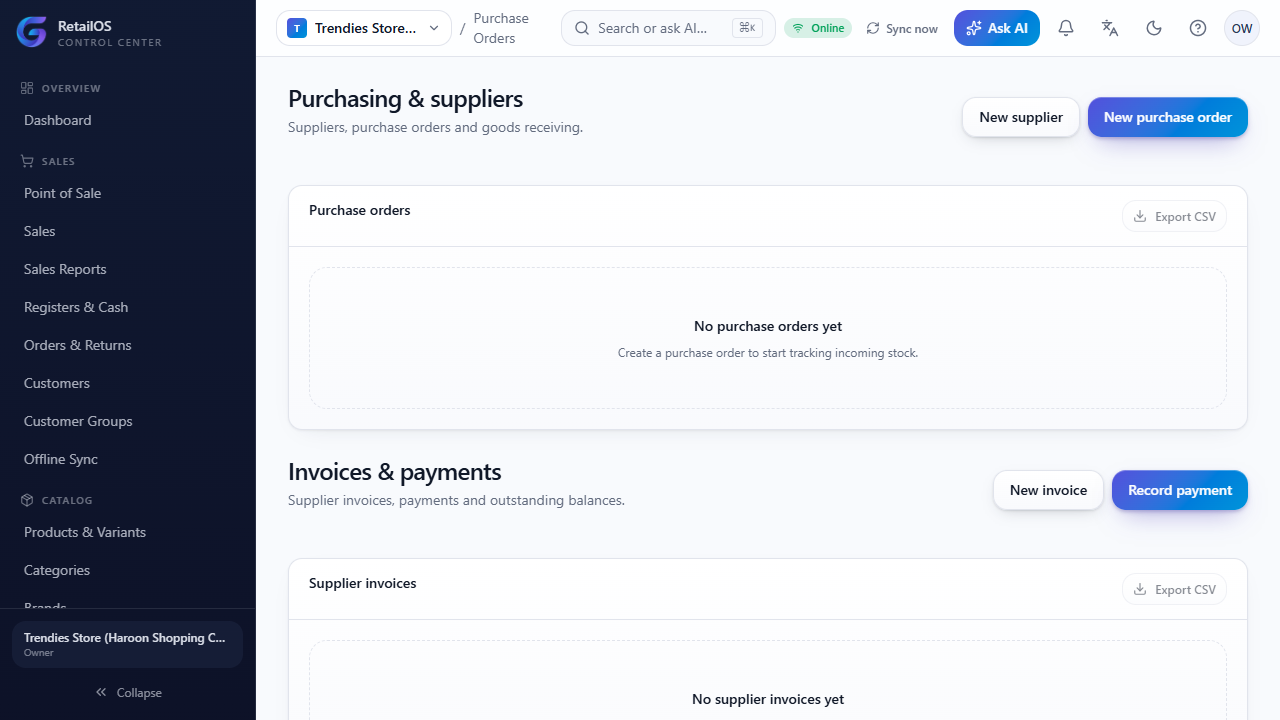
Two admin pages hold most of these forms: Purchasing & suppliers (/admin/purchasing) and Accounting (/admin/accounting). The master-data pages (Suppliers, Chart of accounts, Expense categories, Payment methods) share the generic MasterDataPage component → saveMasterDataFn / setMasterDataActiveFn / deleteMasterDataFn (src/lib/masterdata.functions.ts). Financial writes (invoices, payments, expenses) run through server functions gated by FINANCE_ROLES (owner, admin, manager, accountant).
Supplier — quick add — /admin/purchasing
- Purpose: Fast supplier capture inline on the purchasing page.
- Access: purchasing roles (client insert governed by
suppliersRLS). - Backend: direct
supabase.from("suppliers").insert(...).
| UI label | Field key | Type | Req | Default | Validation / options | Notes |
|---|---|---|---|---|---|---|
| Name | name | text | Yes | "" | non-empty | — |
email | text | No | "" | — | — | |
| Phone | phone | text | No | "" | — | — |
| — | payment_terms | text | auto | net_30 | — | set even though no input is shown here |
Supplier — full record — /admin/suppliers
- Purpose: Maintain the supplier master used by POs, receipts and invoices.
- Access: UI
permission="purchasing". Backend:saveMasterDataFn(entitysuppliers) →suppliers.
| UI label | Field key | Type | Req | Default | Validation / options | Notes |
|---|---|---|---|---|---|---|
| Supplier name | name | text | Yes | — | required | — |
| Code | code | text | No | — | — | — |
email | text | No | — | — | — | |
| Phone | phone | text | No | — | — | — |
| Tax number | tax_number | text | No | — | — | — |
| Payment terms | payment_terms | select | No | — | cod / net_7 / net_15 / net_30 / net_60 | — |
| Credit limit | credit_limit | number | No | — | step 0.01 | — |
| Address | address | textarea | No | — | — | — |
| Active | is_active | boolean | No | true | — | archive toggle |
Connections — referenced by purchase_orders.supplier_id, supplier_invoices.supplier_id; delete blocked while purchase orders reference it (masterdata.server guard).
Purchase order — /admin/purchasing (New purchase order)
- Purpose: Raise a PO against a supplier with one or more product lines, each with its own quantity and unit cost.
- Access: purchasing roles (client writes governed by RLS).
- Backend: direct client writes →
purchase_orders+purchase_order_items; PO number fromdocument_sequences(doc_typepurchase_order).
Pick a supplier, then add one row per product, each with its own quantity and unit cost. Use + Add product to add rows and the row's remove control to delete them; a live running total sums every line as you type. The same product can't appear twice on one PO — combine it into a single line (duplicates are blocked).
| UI label | Field key | Type | Req | Default | Validation / options | Notes | ||
|---|---|---|---|---|---|---|---|---|
| Supplier | supplier_id | uuid (EntitySelect) | No | "" → null | from Suppliers | one supplier per PO | ||
| Product | variant_id | select | Yes | "" | active variants (limit 500) | one row per product; no duplicate products in a PO | ||
| Quantity | quantity | number | Yes | 1 | `Number() | 1` | per line; input selects-on-focus | |
| Unit cost | unit_cost | number | Yes | "" | `Number() | 0` | per line; input selects-on-focus | |
| — | po_number | text | auto | PO-##### | document_sequences prefix+padding, increments next_number | auto; preserved when editing | ||
| — | status | enum | auto | submitted | po_status | auto; preserved when editing | ||
| — | subtotal / total | number | auto | Σ(quantity × unit_cost) across lines | — | auto; the live running total | ||
| — (line) | total | number | auto | quantity × unit_cost | — | auto |
The AI assistant can also create multi-line POs viacreate_purchase_order(ai-actions.server.ts) subject to the AI permission matrix.
Expandable detail, Edit & Cancel. In the purchase-orders list, click a PO row to expand an inline detail table with one row per line — Product · Ordered · Received · Unit cost · Line total. From that expanded detail, and only while nothing has been received on the PO, two actions are available:
- Edit — reopens the form pre-filled so you can change the supplier and replace the line items; the PO number and status are preserved.
- Cancel PO — sets the status to
cancelledafter a confirm prompt.
Once any goods are received, Edit and Cancel disappear and a short note explains the order can no longer be changed — editing a received PO would require reversing already-posted stock and cost postings, which isn't supported.
Connections — references Supplier (supplier_id) and Variant (variant_id, per line); consumed by Receive goods and Supplier invoice (prefill).
Receive goods — /admin/purchasing (per-PO "Receive goods" button)
- Purpose: Post a goods receipt for an open PO — full ordered quantity, no form fields.
- Access: purchasing roles. Backend: direct writes →
goods_receipts+goods_receipt_items,inventory_movements(typepurchase),inventory_balances,variant_costs(upsert), POstatus='received'; GRN number fromdocument_sequences(doc_typegoods_receipt).
| Field | Type | Req | Default | Notes |
|---|---|---|---|---|
purchase_order_id | uuid | auto | the PO | from button |
location_id | uuid | auto | shop default location | "No inventory location configured" if none |
receipt_number | text | auto | GRN-##### | document_sequences |
per line variant_id, quantity, unit_cost | — | auto | from PO items | received at full ordered qty |
Cross-form effects — each line adds stock (inventory_movements purchase + inventory_balances), updates cost (variant_costs.cost_price/avg_cost), stamps purchase_order_items.received_quantity, and flips the PO to received. A goods receipt updates stock and cost operationally only — it posts no journal entry; the inventory asset and the payable are booked when the matching supplier invoice is posted (invoice-time recognition).
Supplier invoice — /admin/purchasing (New supplier invoice)
- Purpose: Record a supplier bill (draft), then Post / Cancel it.
- Access: FINANCE_ROLES. Backend:
saveSupplierInvoice/postSupplierInvoiceFn/cancelSupplierInvoiceFn/createInvoiceFromSourceFn(src/lib/purchasing.functions.ts) →supplier_invoices.
| UI label | Field key | Type | Req | Default | Validation / options | Notes |
|---|---|---|---|---|---|---|
| Supplier | supplier_id | uuid (EntitySelect) | Yes | "" | from Suppliers | — |
| Invoice number | invoice_number | text | Yes | "" | 1–80 chars | — |
| Invoice date | invoice_date | text (date) | No | — | optional | — |
| Due date | due_date | text (date) | No | — | nullable | drives AP ageing / due-soon |
| Total | total | number | Yes | "" | ≥ 0 | — |
| Prefill from purchase order | purchase_order_id | select | No | — | your POs | calls createInvoiceFromSourceFn to draft from a PO/receipt |
| — | goods_receipt_id | uuid | No | null | schema only | alternate source |
| — | notes | text | No | null | ≤2000 | schema only |
| — | status | text | auto | draft | draft → posted → partially_paid / paid / overdue / cancelled | auto |
| — | paid_total | number | auto | 0 | — | auto; updated by payments |
Actions: Post (draft → posted, writes the journal entry Dr Inventory / Cr Accounts Payable for stock items — this is when purchased stock becomes a GL asset), Cancel (only when nothing paid). Connections — Supplier (supplier_id), optional PO (purchase_order_id) / goods receipt (goods_receipt_id); feeds AP ageing and "Outstanding by supplier".
Supplier payment — /admin/purchasing (Record a payment)
- Access: FINANCE_ROLES. Backend:
recordSupplierPaymentFn→supplier_payments(+ journal, updates invoicepaid_total/status).
| UI label | Field key | Type | Req | Default | Validation / options | Notes |
|---|---|---|---|---|---|---|
| Invoice | supplier_invoice_id | select | Yes | "" | invoices in posted / partially_paid / overdue | shows outstanding per option |
| Amount | amount | number | Yes | "" | > 0 | — |
| Method | method_code | select | Yes | cash | cash / bank / card | — |
| Reference | reference | text | No | "" | ≤200 | nullable |
| — | paid_at | text (date) | auto | now | optional | auto |
Cross-form effects — increments the invoice's paid_total, moves it to partially_paid / paid, and posts a balanced journal entry (Dr AP / Cr Cash or Bank).
Record expense — /admin/accounting (Overview tab)
- Purpose: Record an operating expense and post it to the ledger.
- Access: FINANCE_ROLES. Backend:
recordExpense(src/lib/accounting.functions.ts) →recordExpenseAndPost→expenses+journal_entries.
| UI label | Field key | Type | Req | Default | Validation / options | Notes |
|---|---|---|---|---|---|---|
| Category | category_id | select | No | "" → null | from Expense categories | maps to a ledger account |
| Amount | amount | number | Yes | "" | > 0 | — |
| Note | note | text | No | "" | ≤500; ""→null | — |
| Payment method | payment_method_code | select | Yes | cash | cash / bank | default cash |
| — | branch_id | uuid | auto | top-bar Branch filter | nullable | taken from the page's branch filter |
Cross-form effects — writes an expenses row and a balanced journal entry (Dr the category's expense account / Cr Cash or Bank). Also reachable via a cash-drawer expense on /admin/registers (see Cash movement).
Manual voucher (journal / payment / receipt / contra) — /admin/accounting (Vouchers tabs)
- Purpose: Post manual double-entry that the automated flows don't generate — owner capital, bank charges, depreciation, accruals, reclassifications, opening balances.
- Access: create / edit / view / delete = FINANCE_ROLES; approve / post / reverse = MANAGERS (owner/admin/manager). Backend:
createVoucher/updateVoucher/approveVoucher/postVoucher/reverseVoucher(src/lib/vouchers.functions.ts→vouchers.server.ts) →vouchers+voucher_lines; posting writesjournal_entries/journal_entry_lines.
Header fields
| UI label | Field key | Type | Req | Default | Validation / options | Notes |
|---|---|---|---|---|---|---|
| (tab) | voucher_type | — | Yes | journal | journal / payment / receipt / contra (+ sales / purchase / debit_note / credit_note) | picks the number series (JV-/PV-/RV-/CV-…) |
| Date | voucher_date | date | Yes | today | ISO; target period must be open | period-guarded on post |
| Reference | reference | text | No | — | ≤120 | e.g. cheque #, invoice ref |
| Narration | narration | text | No | — | ≤1000 | what the voucher is for |
| Notes | notes | text | No | — | ≤2000 | internal only |
Line grid (voucher_lines, min 2 rows)
| UI label | Field key | Type | Req | Default | Validation / options | Notes |
|---|---|---|---|---|---|---|
| Account | account_id | select | Yes | — | searchable Chart of Accounts | — |
| Debit | debit | number | — | 0 | ≥ 0 | a line is debit or credit, never both |
| Credit | credit | number | — | 0 | ≥ 0 | — |
| Department | department_id | select | No | null | active departments | analytical dimension |
| Cost center | cost_center_id | select | No | null | active cost centers | analytical dimension |
| Narration | narration | text | No | — | ≤300 | per-line memo |
Balanced-entry enforcement — the totals row shows "Out by ₨X" (amber) until debits = credits, then flips to "Balanced"; Save is disabled while unbalanced. validateLines re-checks on the server (and the assert_journal_balanced DB trigger on post): rejects <2 lines ("A voucher needs at least two lines."), a line with both debit and credit, and any imbalance ("Voucher is not balanced…"). Type-specific rules: payment = exactly one Cash/Bank line, credited; receipt = exactly one Cash/Bank line, debited; contra = exactly two Cash/Bank lines (different accounts), one debit + one credit.
Lifecycle — draft → approved → posted → reversed. Save draft creates the voucher with no ledger impact. Open it (View) → Approve (managers) → Post — only posting writes the journal entry and moves the trial balance. A posted voucher shows Reverse, which writes an equal-and-opposite (debits↔credits swapped) contra entry, period-guarded — never by editing the original. Delete is allowed only while draft.
Cross-form effects — posted vouchers appear in General Ledger / Trial Balance / P&L / Balance Sheet identically to automated postings; AUD voucher.* actions logged; department/cost-center dimensions feed the Departments and Cost Centers report tabs.
Chart of accounts — /admin/accounts
- Access: UI
permission="accounting". Backend:saveMasterDataFn(entityaccounts) →accounts.
| UI label | Field key | Type | Req | Default | Validation / options | Notes |
|---|---|---|---|---|---|---|
| Account code | code | text | Yes | — | e.g. 1000; locked on system accounts | — |
| Account name | name | text | Yes | — | required | — |
| Type | type | select | Yes | — | asset / liability / equity / income / expense; locked on system | — |
| Parent account | parent_id | uuid (entity) | No | null | EntitySelect accounts | tree self-reference |
| Active | is_active | boolean | No | true | — | archive toggle |
Connections — journal_entry_lines.account_id, expense_categories.account_id, cash_accounts.account_id, self parent_id. System accounts (is_system) are protected from deletion; the default 14-line chart is provisioned at onboarding.
Expense category — /admin/expense-categories
- Access: UI
permission="accounting". Backend:saveMasterDataFn(entityexpense_categories) →expense_categories.
| UI label | Field key | Type | Req | Default | Validation / options | Notes |
|---|---|---|---|---|---|---|
| Name | name | text | Yes | — | e.g. "Rent" | — |
| Ledger account | account_id | uuid (entity) | No | null | EntitySelect accounts | expense account this category posts to |
| Active | is_active | boolean | No | true | — | archive toggle |
Connections — selected on Record expense (category_id); each category maps to an accounts row via account_id.
Payment method — /admin/payments
- Access: UI
permission="settings". Backend:saveMasterDataFn(entitypayment_methods) →payment_methods.
| UI label | Field key | Type | Req | Default | Validation / options | Notes |
|---|---|---|---|---|---|---|
| Display name | name | text | Yes | — | e.g. "Cash" | — |
| Code | code | text | Yes | — | stable id stored on payments (cash, card…) | — |
| Type | type | select | Yes | — | cash / card / bank / wallet / credit / other | cash types post to the drawer + cash ledger |
| Display order | position | number | No | — | — | — |
| Enabled | is_enabled | boolean | No | true | — | — |
Connections — codes are referenced by POS payments, supplier payments and expenses. (Note: storefront checkout uses a hardcoded cod/bank/card list, not this table.)
Financial reports (read-only) — /admin/accounting
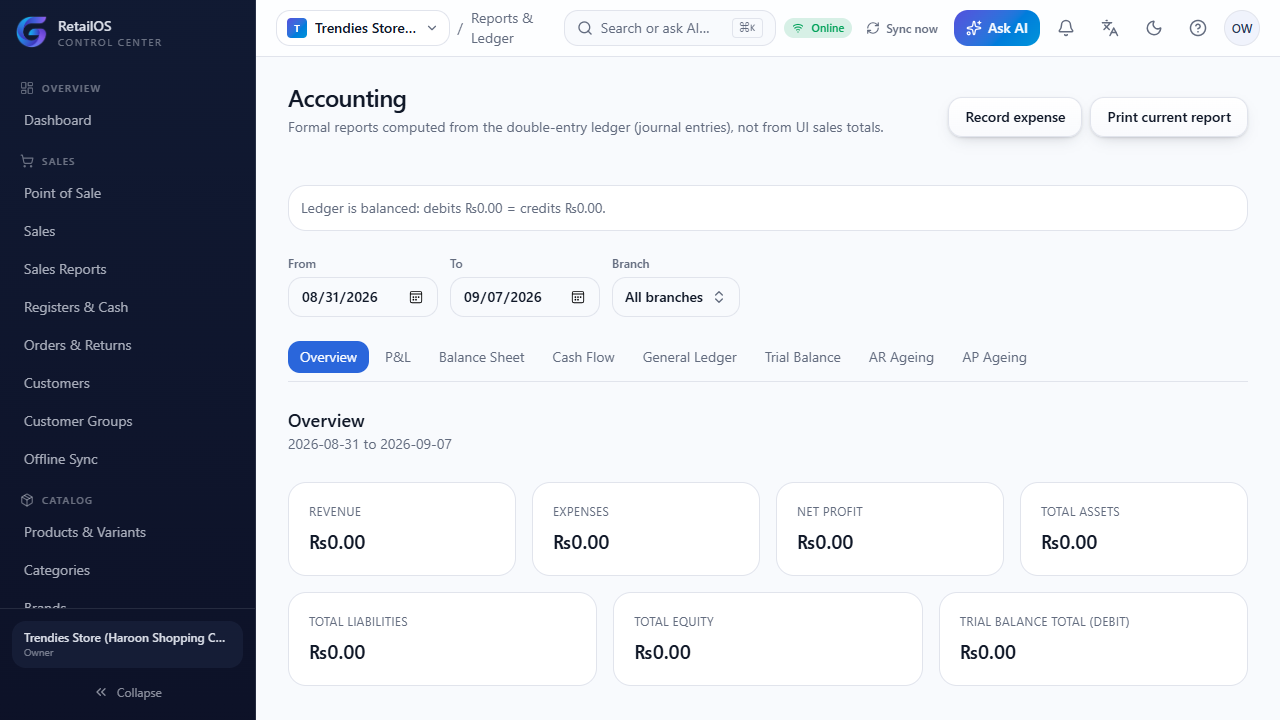 Tabs computed from the double-entry ledger (
journal_entries / journal_entry_lines), not from UI sales totals. Shared filters: From / To date range, Branch, and (Ledger tab) Account; a Print current report button.
| Tab | Server fn | Filters |
|---|---|---|
| Overview | P&L + Balance sheet + Trial balance | range, branch |
| P&L | getProfitAndLoss | range, branch |
| Balance Sheet | getBalanceSheet | as-of (range end), branch |
| Cash Flow | getCashFlow | range, branch |
| General Ledger | getGeneralLedger | range, account, limit 500 |
| Trial Balance | getTrialBalance | range, branch |
| AR Ageing | getArAgeing | as-of |
| AP Ageing | getApAgeing | as-of |
A ledger-integrity banner (getBalanceValidation) warns if total debits ≠ total credits in the range.
The same /admin/accounting page also hosts operational tabs beyond these read-only reports: Journal / Payment / Receipt / Contra Vouchers (see Manual voucher above), Fiscal Years / Periods (open/close periods — the posting guard that blocks back-dating into a closed month), Departments and Cost Centers (analytical dimensions tagged on voucher lines), and Bank Reconciliation (match statement lines against ledger cash/bank movements until the difference is zero).
Tables owned: suppliers (shop_id→shops), purchase_orders (shop_id→shops, supplier_id→suppliers; po_status; unique (shop_id, po_number)), purchase_order_items (purchase_order_id→purchase_orders, variant_id→product_variants), goods_receipts (purchase_order_id→purchase_orders, location_id→inventory_locations; unique (shop_id, receipt_number)), goods_receipt_items (goods_receipt_id→goods_receipts, variant_id→product_variants), supplier_invoices (supplier_id→suppliers, purchase_order_id→purchase_orders, goods_receipt_id→goods_receipts; payment_status), supplier_payments (supplier_invoice_id→supplier_invoices), accounts (self-FK parent_id; account_type; is_system), journal_entries (shop_id→shops, branch_id→branches), journal_entry_lines (journal_entry_id→journal_entries, account_id→accounts), expenses (category_id→expense_categories, branch_id→branches), expense_categories (account_id→accounts), payment_methods (shop_id→shops), bank_accounts (account_id→accounts).
Budgets — /admin/budgets
- Purpose: Annual budgets by account (optionally per month) with Budget vs Actual computed against the live ledger (posted actuals only).
- Access: view / edit draft lines = FINANCE_ROLES; Approve = owner/admin. Backend:
createBudget/getBudget/upsertBudgetLine/setBudgetStatus/budgetVsActual(src/lib/finance-reports.functions.ts→finance-reports.server.ts) →budgets+budget_lines.
Create + line fields
| UI label | Field key | Type | Req | Default | Validation / options | Notes |
|---|---|---|---|---|---|---|
| Budget name | name | text | Yes | — | non-empty | e.g. "FY2026 Operating Budget"; created as draft, version 1 |
| Account code | account_code | text | Yes | — | must exist in Chart of Accounts (resolved to account_id server-side) | e.g. 6200 |
| Amount | amount | number | Yes | — | numeric > 0 (letters/blank → "Enter a numeric amount greater than zero.") | per-account budgeted figure |
Lines — added on the Budget lines tab while the budget is draft. Enter an account code + amount and press Add / update line: the code is resolved against the Chart of Accounts server-side and the line is upserted (re-entering the same code updates its amount instead of duplicating). Lines become read-only once the budget is approved.
Budget vs Actual — the second tab compares each budgeted account to its posted ledger actual (year-to-date): Budget, Actual, Variance and Variance %, with over-budget variance highlighted amber. (Procurement requisitions can reference a budget for encumbrance context.)
Lifecycle — draft → approved (Approve, owner/admin). Only draft budgets accept line edits.
Connections — budget_lines.account_id→accounts; budgets.fiscal_year_id→fiscal_years (optional); actuals read from posted journal_entry_lines.
Receivables & Payables (ageing statements) — /admin/receivables, /admin/payables
- Purpose: Read-only ageing of customer (AR) and supplier (AP) outstanding balances, bucketed Current / 1–30 / 31–60 / 61–90 / 90+ as of a chosen date. Click a row to open that party's running statement (opening balance → dated debits/credits → closing balance).
- Access: FINANCE_ROLES. Backend:
getArAgeing/getApAgeing+ per-party statement (finance-reports.server.ts), derived from sales & their tenders (AR — cash sales excluded) andsupplier_invoices/supplier_payments(AP). - Settlement is done elsewhere — these pages are read-only. Clear an AR balance from Sales → Record payment on the sale; clear an AP balance from Purchasing → Record a payment on the supplier invoice. The balance drops to zero once the settling payment posts (Dr Bank/Cash · Cr Accounts Receivable, or Dr Accounts Payable · Cr Bank/Cash), and the trial balance stays balanced.
Sales — POS, Registers, Orders & Sync
POS sale (cart) — /admin/pos
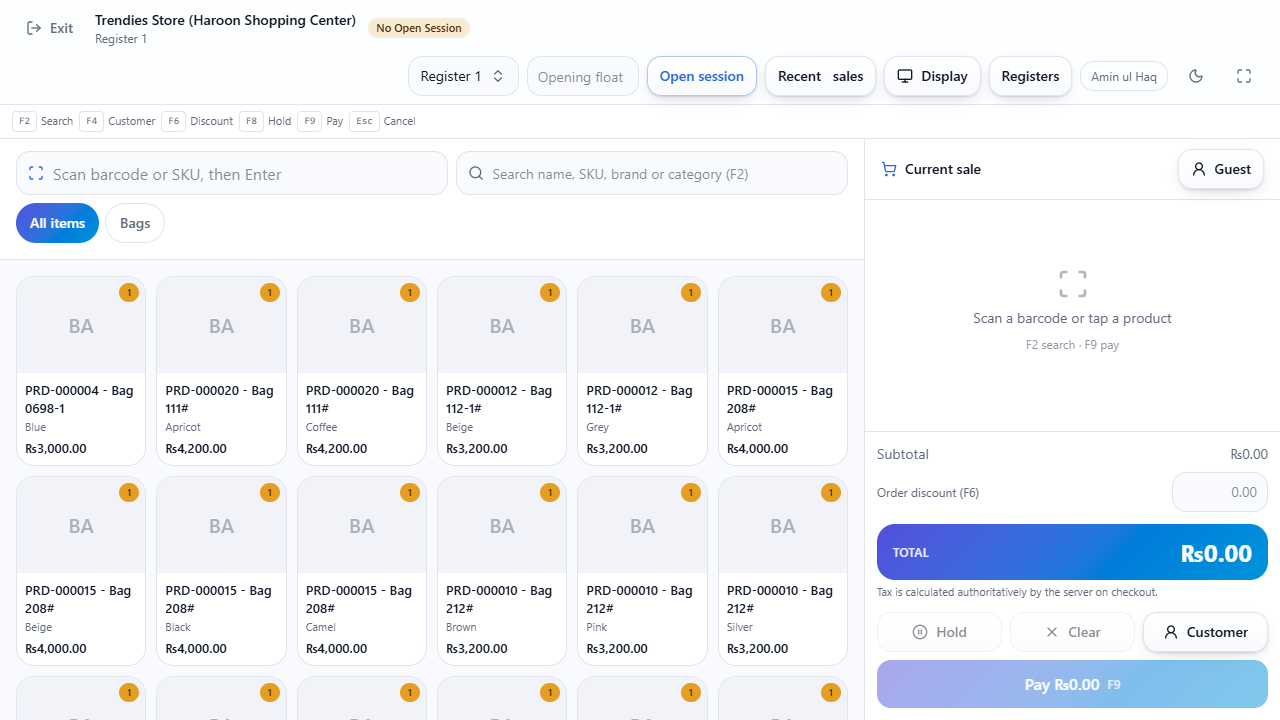
- Purpose: Build a retail cart (scan/tap products, per-line and order discounts, attach customer, hold/resume) and start checkout.
- Access: SELLING_ROLES = owner, admin, manager, cashier (enforced by
posCheckout). - Backend:
posCheckout(src/lib/pos.functions.ts) →recordPosSale(src/lib/pos.server.ts) →record_pos_saleRPC →orders,order_items,payments,receipts,inventory_movements/inventory_balances,journal_entries,cash_movements.
Order-level fields
| UI label | Field key | Type | Req | Default | Validation / options | Notes |
|---|---|---|---|---|---|---|
| Register (header select) | register_id | uuid | No | first open/first register | must be a shop register | null allowed |
| (scan box) | scan/SKU | text | — | — | matches barcode or SKU | Enter adds item; not persisted |
| Search (F2) | search | text | No | — | client filter, ≤60 shown | not persisted |
| Category chips | category | text | No | all | derived from catalog | client filter |
| Guest / Customer (F4) | customer_id | uuid | No | null (Guest) | select from customers | attach/detach |
| Order discount (F6) | cartDiscount | number | No | 0 | capped at gross − lineDiscounts | spread evenly across lines on submit |
| — | local_uuid | text(≤80) | auto | crypto.randomUUID() | idempotency key | dedup on (shop_id, local_uuid) |
| — | notes | text(≤500) | No | null | — | in schema; not sent by POS online path |
| — | branch_id | uuid | No | null | — | not in POS UI |
| Subtotal | gross | number | auto | — | Σ price×qty | auto |
| Discounts | line+order disc | number | auto | — | Σ line.discount + orderDiscount | auto |
| Tax | taxTotal | number | auto | — | per line: the product's tax rate, else the shop default; inclusive or exclusive | auto; shown when > 0, labelled Incl. tax for tax-inclusive rates |
| Total | total | number | auto | — | net subtotal + tax | auto; equals the authoritative server priceCart total — the client prices each line with the same shared helpers (resolveLineTax / priceLine / sumPricedLines), so the cashier collects exactly what the server posts |
Cart lines (UI Line; server posLine)
| UI label | Field key | Type | Req | Default | Validation / options | Notes |
|---|---|---|---|---|---|---|
| (product) | variant_id | uuid | Yes | — | valid variant | one row per variant |
| Qty (−/input/+) | quantity | number | Yes | 1 | 0.001–9999; ≤0 removes line | numeric(14,3) |
| Disc. | discount | number | No | 0 | ≥0, max 1,000,000 | submitted as line.discount + perLineOrderDiscount |
| line amount | line total | number | auto | — | price×qty − discount | auto |
Offline snapshot (sent only on offline queue / sync retry — client_snapshot): device_id (text ≤80, marks orders.is_offline), local_seq (int), offline_created_at (ISO), and immutable client_snapshot.{lines, subtotal, discount_total, tax_total, total} — the "as-charged" record the server reconciles against; variance → pos_sync_conflicts.
Keyboard shortcuts: F2 Search · F4 Customer · F6 Order discount · F8 Hold · F9 Pay · Esc Cancel/close (↑/↓/←/→ move the grid highlight; Enter in search adds the highlighted item). Hold/Resume held sales are client-only state (no backend).
Connections
- Selects / references: Variant/Product (catalog +
inventory_balances), Customer (customer_id), Register (register_id); opencash_sessionsresolved server-side. - Feeds / used by: completed sale →
order_items,payments,inventory_movements,receipts,journal_entries(Dr Cash 1000/Bank 1100; Cr Revenue 4000 + Tax 2100; Dr COGS 5000 / Cr Inventory 1200),cash_movements; low-stock →ai_alerts. - Cross-form effects: server is the pricing authority (recomputes via
priceCart); payment total must equal order total within currency tolerance; duplicatelocal_uuidreturns the existing order; offline/failed sales queue to/admin/sync.
Payment screen — /admin/pos (Pay modal, F9)
- Purpose: Allocate split payments across methods and compute change, then complete the sale.
- Access: SELLING_ROLES. Backend: same as POS Sale →
payments(+cash_movementsfor cash).
Split-payment rows (UI PaymentRow; server payments[])
| UI label | Field key | Type | Req | Default | Validation / options | Notes |
|---|---|---|---|---|---|---|
| Method tiles / Pay N select | method_code | text(≤40) | Yes | cash | cash, card, bank, credit, other | cash→acct 1000, else→bank 1100 |
| Pay N amount | amount | number | Yes | subtotal (first row) | ≥0; only rows >0 submitted | numeric(14,2) |
| — | reference | text(≤120) | No | — | — | in schema; not in POS UI |
| — | status | text | auto | captured | — | auto |
| Allocated | allocated | number | auto | — | Σ amounts | auto |
| Remaining | remaining | number | auto | — | subtotal − allocated | auto |
| Change due | changeDue | number | auto | — | max(0, allocated − subtotal) | auto; returned as change |
≥1 payment required; "Split payment" adds a row prefilled with the remaining. Complete is enabled only when fully allocated (allocated ≥ subtotal, some amount >0, subtotal >0).
Credit (pay later) — udhaar. When Settings → Customers & credit has credit sales on and the signed-in user's role is permitted (credit_roles), the Pay screen shows a Credit sale (udhaar / pay later) toggle. With it ticked the button becomes Complete credit sale and the sale can post with partial or zero tender — the unpaid remainder is booked to the customer's account (Accounts Receivable) and the order is marked partial or unpaid.
- A customer is required — a credit sale can't complete as a guest (you're prompted to attach one first).
- The customer's credit limit is enforced: their existing outstanding balance + this sale must stay within their
credit_limit(0= unlimited). A manager sees an Override the customer's credit limit checkbox to push past it. - Credit sales are online-only — they're server-validated and are never queued offline. Settle the balance later via Sales → Record payment.
Open cash session — /admin/pos header & /admin/registers
- Purpose: Open a register drawer with an opening float.
- Access: any active member; non-managers must be assigned to the register.
- Backend:
openCashSession(src/lib/cash.functions.ts) →cash_sessions+cash_movements(opening).
| UI label | Field key | Type | Req | Default | Validation / options | Notes |
|---|---|---|---|---|---|---|
| (register select) | registerId | uuid | Yes | — | shop register | — |
| Opening float | openingBalance | number | Yes | 0 | ≥0 | rejected if register already has an open session |
| — | status | text | auto | open | — | auto |
| — | opened_by / opened_at | uuid / ts | auto | caller / now | — | auto |
Cash movement (in/out/expense) — /admin/registers (session panel)
- Purpose: Record cash added to / removed from an open drawer, or a cash expense.
- Access: any active member; UI enables only for managers or the assigned opener.
- Backend:
recordCashMovement(cash.functions.ts) →cash_movements(+recordExpenseAndPost→ expense +journal_entrieswhen type=expense).
| UI label | Field key | Type | Req | Default | Validation / options | Notes |
|---|---|---|---|---|---|---|
| (session context) | sessionId | uuid | Yes | selected session | must be open | — |
| Type | movementType | enum | Yes | cash_in | cash_in, cash_out, expense | — |
| Amount | amount | number | Yes | — | >0 (min 0.01) | numeric |
| Note | note | text(≤300) | No | null | — | — |
| — | categoryId | uuid | No | null | expense category | only for expense; not in registers UI |
| — | reference_type/reference_id | text/uuid | auto | null | set to expense/expenseId | auto when expense |
Close cash session — /admin/pos header & /admin/registers
- Purpose: Count the drawer and close the session, computing variance vs expected.
- Access: any member; only the opener or a manager may close.
- Backend:
closeCashSession(cash.functions.ts) →cash_sessionsupdate +cash_movements(closing) +ai_alerts(on discrepancy).
| UI label | Field key | Type | Req | Default | Validation / options | Notes |
|---|---|---|---|---|---|---|
| (session context) | sessionId | uuid | Yes | selected/open session | must be open | — |
| Counted cash | countedBalance | number | Yes | 0 | ≥0 | numeric(14,2) |
| Expected | closing_balance | number | auto | — | opening + cash_sales − cash_refunds + cash_in − cash_out − expenses | auto |
| Difference | discrepancy | number | auto | — | counted − expected | auto; alert if abs>0 (critical if >5% of expected) |
| — | closed_at / status | ts / text | auto | now / closed | — | auto |
Read-only reconciliation stats: Opening, Cash sales, Refunds, Cash in, Cash out, Expenses, Expected, Counted, Difference.
Register create / edit / assign — /admin/registers
- Access: MANAGERS = owner, admin, manager. Backend:
createRegister/updateRegister/assignRegisterUser/unassignRegisterUser(cash.functions.ts) →registers,register_users.
Create/edit
| UI label | Field key | Type | Req | Default | Validation / options | Notes |
|---|---|---|---|---|---|---|
| Name | name | text | Yes | — | 1–120 chars | — |
| Code | code | text | No | null | ≤40 chars | — |
| — | branch_id | uuid | No | null | shop branch | not in UI |
| Active/Inactive (toggle) | is_active | boolean | No | true | — | the only field edit UI toggles |
Assign users — per-member checkbox writes register_users (registerId + userId, idempotent, unique (register_id,user_id)).
Connections (registers) — references Register (register_id), Branch (branch_id), staff from shop_users, session (cash_session_id). An open register session gates POS selling; movements + sessions feed reconciliation and journal entries; discrepancies raise ai_alerts. One open session per register; refunds land back in the originating open session's drawer.
Return / refund — /admin/orders (order detail)
- Purpose: Return order lines, optionally restock, and issue a refund.
- Access: MANAGERS (refunds move money out).
- Backend:
posRefund(pos.functions.ts) →recordReturn→record_pos_returnRPC →returns,return_items,refunds,inventory_movements(restock),journal_entries(reversing),cash_movements,ordersstatus.
Header fields
| UI label | Field key | Type | Req | Default | Validation / options | Notes |
|---|---|---|---|---|---|---|
| (order) | orderId | uuid | Yes | — | order in shop | — |
| Reason | reason | text(≤300) | No | null | dropdown | UI: Reason dropdown (e.g. "Customer changed mind") |
| Refund method | method_code | text(≤40) | No | cash | cash refunds re-enter open drawer | UI: Refund method selector (Cash …) |
| Refund total | total | number | auto | — | Σ proportional line totals; must be >0 | auto |
| Return number | return_number | text | auto | — | per-shop unique | auto |
Return lines (server items[])
| UI label | Field key | Type | Req | Default | Validation / options | Notes |
|---|---|---|---|---|---|---|
| (line) | order_item_id | uuid | Yes | — | belongs to order | — |
| Qty | quantity | number | Yes | 0 | ≥0; clamped to remaining (sold − already returned) | UI: per-line Return quantity input (partial returns supported) |
| Restock | restock | boolean | No | true | toggles inventory return | UI: Restock returned items toggle (default on); restocked units reverse COGS |
The admin.orders.tsx Return items modal surfaces per-line return quantity (partial returns), a Reason dropdown, a Refund method selector, and a Restock returned items toggle; the live Refund ≈ estimate updates as you set quantities, and Confirm return posts the reversing entry. Verified example: a partial return of one line on a ₨16,399 sale created RET-000001 (₨3,499 refund), set the order payment status to partial, restocked the unit, and reduced Revenue −₨3,499 + COGS −₨1,800 in the ledger (still balanced; A = L + E holds).
Sales — list & detail — /admin/sales
- Purpose: Browse every counter / online / AI sale in one place, open a sale for full detail, and record a payment to settle a credit/partial balance.
- Access: view a sale's detail =
owner,admin,manager,cashier,accountant(getSaleDetail); Record payment =owner,admin,manager,accountant(recordSalePayment). - Backend: list via a direct
ordersread; detail viagetSaleDetail; payment viarecordSalePayment(src/lib/orders.functions.ts) →record_order_paymentRPC →payments(+ updatesorders.paid_total/payment_status).
List filters
| UI label | Field key | Type | Req | Default | Validation / options | Notes |
|---|---|---|---|---|---|---|
| Search | search | text | No | "" | matches order_number / contact_email / contact_phone | — |
| Channel | channel | select | No | all | all / pos / online / ai | — |
| Payment | payment | select | No | all | all / paid / partial / unpaid (credit) / refunded | — |
| From / To | dateFrom / dateTo | date | No | — | filter on created_at | — |
Each row shows Sale # · Date · Channel · Customer · Payment · Total · Outstanding (Total − Paid). View opens a read-only detail modal: line items (qty / unit / discount / tax / total), the subtotal → discount → tax → shipping → Total breakdown, Paid vs Outstanding, the tenders (payments), plus customer, register, cashier and any returns.
Record payment — shown in the detail modal only while a sale still has an outstanding balance (a credit / partial sale):
| UI label | Field key | Type | Req | Default | Validation / options | Notes |
|---|---|---|---|---|---|---|
| Amount | amount | number | Yes | — | > 0 | Full balance button fills the outstanding amount |
| Method | method_code | select | Yes | cash | cash / card / bank / other | — |
Recording a payment increments paid_total, moves the sale to partial / paid, and adds a tender row — the same settlement path used to clear udhaar balances taken at the till.
Offline sync — queue & conflict resolution — /admin/sync
- Purpose: Retry queued offline sales and resolve server-side price/tax/rejected conflicts (accept / reject / retry).
- Access: viewing = any member; resolve/discard/retry = owner, admin, manager (DESTRUCTIVE_ROLES).
- Backend:
syncOfflineSales(pos.functions.ts, batch ≤50);listSyncConflicts/resolveSyncConflict(sync.functions.ts) →pos_sync_conflicts(+recordPosSaleon retry ofrejected).
Conflict resolution fields
| UI label | Field key | Type | Req | Default | Validation / options | Notes | ||
|---|---|---|---|---|---|---|---|---|
| (row) | conflictId | uuid | Yes | — | conflict in shop | — | ||
| Retry / Accept / Reject | action | enum | Yes | — | accept \ | reject \ | retry | accept→resolved; reject→rejected; retry→re-post (rejected) or bump attempts |
| Note | note | text(≤500) | No | null | disabled unless status pending/retrying | stored in resolution | ||
| Kind | kind | text | auto | — | price_variance / tax_variance / rejected | auto | ||
| Status | status | text | auto | pending | pending/retrying/resolved/rejected | auto | ||
| Offline vs Server total | snapshot.total / server_state.total | number | auto | — | display only | auto | ||
| Attempts | attempts | int | auto | 1 | +1 per retry | auto |
Local device queue ("On this device" / "Rejected on this device", IndexedDB via src/lib/offline, not a DB table): Retry resends the PendingSale payload (incl. device_id, local_seq, offline_created_at, client_snapshot) via syncOfflineSales; Discard (manager-only) drops the local pending sale/conflict.
Connections
- Selects / references: conflicts reference
register_id,branch_id,device_id,local_uuid,cashier_id; payload holds the original sale + snapshot,server_stateholds the server re-price. - Feeds / used by: retrying a
rejectedconflict/queued sale callsrecord_pos_sale(idempotent onlocal_uuid); variance conflicts already have a posted order and only log the variance. - Cross-form effects: every offline sale failing validation is recorded as a
rejectedconflict rather than lost; the server never overwrites a posted order — it honours the as-charged snapshot and records the difference here.
Tables owned: orders (FKs shop_id→shops, branch_id→branches, register_id→registers, cash_session_id→cash_sessions, customer_id→customers; unique (shop_id, order_number), partial-unique (shop_id, local_uuid)), order_items (order_id→orders, variant_id→product_variants), payments (order_id→orders), receipts (order_id→orders; unique (shop_id, receipt_number)), returns (order_id→orders; unique (shop_id, return_number)), return_items (return_id→returns, order_item_id→order_items, variant_id→product_variants), refunds (order_id→orders, return_id→returns), registers (branch_id→branches), register_users (register_id→registers; unique (register_id, user_id)), cash_sessions (register_id→registers), cash_movements (cash_session_id→cash_sessions, register_id→registers; type sale/refund/expense/cash_in/cash_out/opening/closing), cash_accounts (account_id→accounts), pos_sync_conflicts (branch_id→branches, register_id→registers; unique (shop_id, local_uuid)).
Storefront Editor & AI (Admin)
All Storefront Editor forms load via getAdminStorefrontFn → getAdminStorefront (src/lib/storefront-admin.server.ts), returning { shop, settings, banners, sections, navigation, policies, pages, themes } for the active shop. All writes require owner / admin / manager (assertManager). The editor is a single route with tabs (theme, banners, sections, navigation, pages, policies, contact, domains) plus an opt-in live-preview iframe of /store/<slug>?preview=1.
Draft vs Publish model:
- Theme tab writes go into
storefront_settings.draft(a JSON blob) viasaveSettingsDraftFnand never touch live columns until publish. - Banners / Sections / Navigation rows are written with
is_draft = trueon every save. - Publish (
publishStorefrontFn): copies each key inSETTINGS_DRAFT_KEYSfromdraftinto live columns, setsis_published = true, clearsdraft = {}, and flipsis_draft = falseon all draft banner/section/nav rows. - Discard draft (
discardStorefrontDraftFn): clearsdraft = {}and deletes banner/section/nav rows stillis_draft = true. - Pages, Policies, Contact/Branding write straight to live (no draft staging); Pages/Policies have their own
is_publishedflag.
Theme — /admin/storefront (tab: Theme)
- Purpose: Colours, layout variant, font, hero, announcement bar, social links, SEO meta.
- Backend:
saveSettingsDraftFn(src/lib/storefront-admin.functions.ts) →storefront_settings.draft(JSON merge). "Reset to theme default" calls the same fn with only colour/font keys.
Saved as one draft patch. Colour fields initialise from the theme's own palette when the shop hasn't genuinely customised them (customColor / THEME_DEFAULT_SETTINGS, src/lib/storefront-theme.ts).
| UI label | Field key (patch) | Type | Req | Default | Validation / options | Notes |
|---|---|---|---|---|---|---|
| Homepage variant | homepage_variant | select | — | "index" | from themes[0].variants[].code, else index/index-2…index-5 | — |
| Primary | primary_color | color/hex | — | #0A69D8 | free hex + picker | legacy default #ff6a00 treated as "not customised" |
| Secondary | secondary_color | color/hex | — | #333333 | — | legacy default #111111 |
| Accent | accent_color | color/hex | — | #ffa500 | — | legacy default #f5a623 |
| Text | text_color | color/hex | — | #333333 | — | — |
| Background | background_color | color/hex | — | #ffffff | — | — |
| Font family (optional) | font_family | text | — | "" | empty → saved as null (keeps theme typography) | — |
| Hero title | hero.title | text | — | "" | packed into hero JSON | — |
| Hero subtitle | hero.subtitle | text | — | "" | — | — |
| Hero image | hero.image_url | image URL | — | "" | AdminImageUpload folder cms | — |
| Hero CTA label | hero.cta_label | text | — | "" | — | — |
| Show announcement bar | announcement_bar.enabled | checkbox | — | false | — | — |
| Announcement text | announcement_bar.text | text | — | "" | — | — |
| Facebook / Instagram / TikTok / WhatsApp | social_links.* | text | — | "" | packed into social_links JSON | — |
| Meta title | seo.title | text | — | "" | packed into seo JSON | feeds storefront <title> |
| Meta description | seo.description | text | — | "" | — | feeds meta description |
| Meta keywords | seo.keywords | text | — | "" | — | — |
Reset to theme default patches the five colours + font_family to THEME_DEFAULT_SETTINGS, leaving hero/announcement/social/SEO untouched. Still requires Publish. Persisted draft keys (SETTINGS_DRAFT_KEYS): homepage_variant, primary/secondary/accent/text/background_color, font_family, announcement_bar, header, footer, hero, social_links, seo, theme_code (header/footer/theme_code are draftable but not in this UI).
Banners — /admin/storefront (tab: Banners)
- Backend:
saveBannerFn/deleteBannerFn→storefront_banners. Every save setsis_draft = true.
| UI label | Field key | Type | Req | Default | Validation / options | Notes |
|---|---|---|---|---|---|---|
| — | id | uuid | — | null (new) | present → update | — |
| Placement | placement | select | Yes | "hero" | hero, promo | — |
| Position | position | number | Yes | (count+1)*10 | int ≥ 0 | ↑/↓ buttons |
| Title | title | text | — | "" | nullable | "(untitled)" if blank |
| Subtitle | subtitle | text | — | "" | nullable | — |
| Banner image | image_url | image URL | — | "" | folder cms wide | — |
| Link URL | link_url | text | — | "" | nullable | — |
| Visible | is_visible | checkbox | Yes | true | — | — |
| — | is_draft | boolean | auto | true on save | — | cleared on publish |
Sections — /admin/storefront (tab: Sections)
- Backend:
saveSectionFn/deleteSectionFn→storefront_sections. Save setsis_draft = true.
| UI label | Field key | Type | Req | Default | Validation / options | Notes |
|---|---|---|---|---|---|---|
| — | id | uuid | — | null | — | — |
| Page slug | page_slug | text | Yes | "home" | which storefront page | — |
| Section type | section_type | select | Yes | featured_categories | featured_categories, featured_products, flash_deals, product_section, promotional, footer | — |
| Title | title | text | — | "" | nullable | — |
| Position | position | number | Yes | (count+1)*10 | int ≥ 0 | — |
| Visible | is_visible | checkbox | Yes | true | — | — |
| Section image | config.image_url | image URL | — | — | stored in config JSON | — |
| Config (JSON) | config | JSON textarea | Yes | {} | must parse ("Config must be valid JSON") | free-form block config |
| — | is_draft | boolean | auto | true on save | — | — |
Navigation — /admin/storefront (tab: Navigation)
- Backend:
saveNavItemFn/deleteNavItemFn→storefront_navigation. Save setsis_draft = true.
| UI label | Field key | Type | Req | Default | Validation / options | Notes |
|---|---|---|---|---|---|---|
| — | id | uuid | — | null | — | — |
| Location | location | select | Yes | "header" | header, footer | — |
| Label | label | text | Yes | "" | min 1 | — |
| URL (relative) | url | text | Yes | "" | empty allowed; col NOT NULL | rendered as /<url> |
| Position | position | number | Yes | (count+1)*10 | int ≥ 0 | — |
| Visible | is_visible | checkbox | Yes | true | — | — |
| — | parent_id | uuid | — | null | self-FK for nesting | not in UI |
| — | is_draft | boolean | auto | true on save | — | — |
Pages — /admin/storefront (tab: Pages)
- Backend:
savePageFn/deletePageFn→storefront_pages(live, no draft staging).
| UI label | Field key | Type | Req | Default | Validation / options | Notes |
|---|---|---|---|---|---|---|
| — | id | uuid | — | null | — | — |
| Slug | slug | text | Yes | "" | min 1 | unique (shop_id, slug) |
| Title | title | text | Yes | "" | min 1 | — |
| Published | is_published | checkbox | Yes | false | col default true | "· unpublished" in list |
| (content) | content | textarea | Yes* | "" | empty allowed | body text |
Policies — /admin/storefront (tab: Policies)
- Backend:
savePolicyFn→storefront_policies(upsert onshop_id, policy_type, live).
| UI label | Field key | Type | Req | Default | Validation / options | Notes |
|---|---|---|---|---|---|---|
| Page | policy_type | select | Yes | "privacy" | privacy, terms, return, shipping, faq | selects which row is edited |
| — | title | text | auto | from POLICY_TYPES map | min 1 | derived, not a visible input |
| (content) | content | textarea | Yes* | existing / "" | — | — |
| Published | is_published | checkbox | Yes | true | — | — |
POLICY_TYPES titles: Privacy Policy, Terms & Conditions, Return Policy, Shipping Policy, FAQ.
Branding & Contact — /admin/storefront (tab: Contact)
- Backend:
saveContactInfoFn→shopstable (not a storefront_* table). Written live.
| UI label | Field key | Type | Req | Default | Validation / options | Notes |
|---|---|---|---|---|---|---|
| Store name | name | text | — | shop.name | only written if non-empty | updates shops.name |
| Tagline | tagline | text | — | shop.tagline | nullable | — |
| Store logo | logo_url | image URL | — | shop.logo_url | folder branding | header + receipts |
| Favicon | favicon_url | image URL | — | shop.favicon_url | folder branding | browser tab icon |
| Phone | phone | text | — | shop.phone | nullable | — |
email | text | — | shop.email | nullable | — | |
whatsapp | text | — | shop.whatsapp | nullable | — | |
| Address | address | text | — | shop.address | nullable | — |
Storefront Connections
- Selects / references: Sections/banners reference categories & products (via
configJSON / links); Navigation URLs point at storefront customer pages; Pages & Policies render as customer info pages. - Feeds / used by: all published rows drive the public storefront at
/store/<shop.slug>;seofeeds meta tags; theme colours/font inject storefront CSS; branding feeds header + receipts. Public reads are RLS-gated tois_visible AND NOT is_draft. - Cross-form effects: Theme + banner/section/nav changes stay hidden until Publish; currency/language/timezone are managed in
/admin/settings, not here.
Domains (connect your own domain) — /admin/storefront (tab: Domains)
- Purpose: Connect your own domain(s) (e.g.
trendies.pk) so your storefront is served at clean root URLs on your own brand —https://trendies.pk/,/product/<slug>,/cart,/checkout— with no/store/<slug>/prefix. The original/store/<shopSlug>/*links keep working. - Access: owner / admin only (
requireRole(..., ADMINS)). - Backend:
listDomainsFn/addDomainFn/verifyDomainFn/setPrimaryDomainFn/removeDomainFn(src/lib/domains.functions.ts) →domains.server.ts→shop_domainstable.
| UI label | Field key | Type | Req | Default | Validation / options | Notes |
|---|---|---|---|---|---|---|
| Add a domain | hostname | text | Yes | — | 3–253 chars; one shop per host (case-insensitive) | e.g. trendies.pk or www.trendies.pk |
| — | verification_status | enum | auto | pending | pending / verified / failed | status badge per row |
| — | is_primary | boolean | auto | false | one primary per shop | set via Make primary (verified only); others redirect to it |
Merchant flow
- Add the domain — Storefront → Domains, type the host, click Add domain (lists as Pending).
- Create the DNS records at your registrar: an A record (
@→185.158.133.1) plus the_lovableTXT verification record — use the exact values shown on screen. - The platform verifies ownership and issues the SSL certificate (the free
https://padlock). - Once the domain resolves to your store, click Mark verified — it switches to Verified and your storefront goes live on it.
- (Optional) If you added more than one (e.g. apex +
www), click Make primary; secondary domains redirect to the primary. - (Optional) Serves — each domain has a Serves selector (shown as soon as the domain is added, even before DNS verification) choosing WHAT it serves at its root: Online store (default — the storefront, as above) or Restaurant website (the
/dinesite from Restaurant → Website). A restaurant-assigned domain opens the restaurant site at/and is its own home — it is not redirected to the store's primary domain. Changing it saves immediately and is recorded in the audit log (shop_site.domain_assigned).
Unknown / unverified hosts never resolve to a shop, and one domain maps to exactly one shop. Full registrar-by-registrar steps (including Namecheap) are in the in-app guide at /admin/domain-setup.
AI (Admin) — /admin/ai
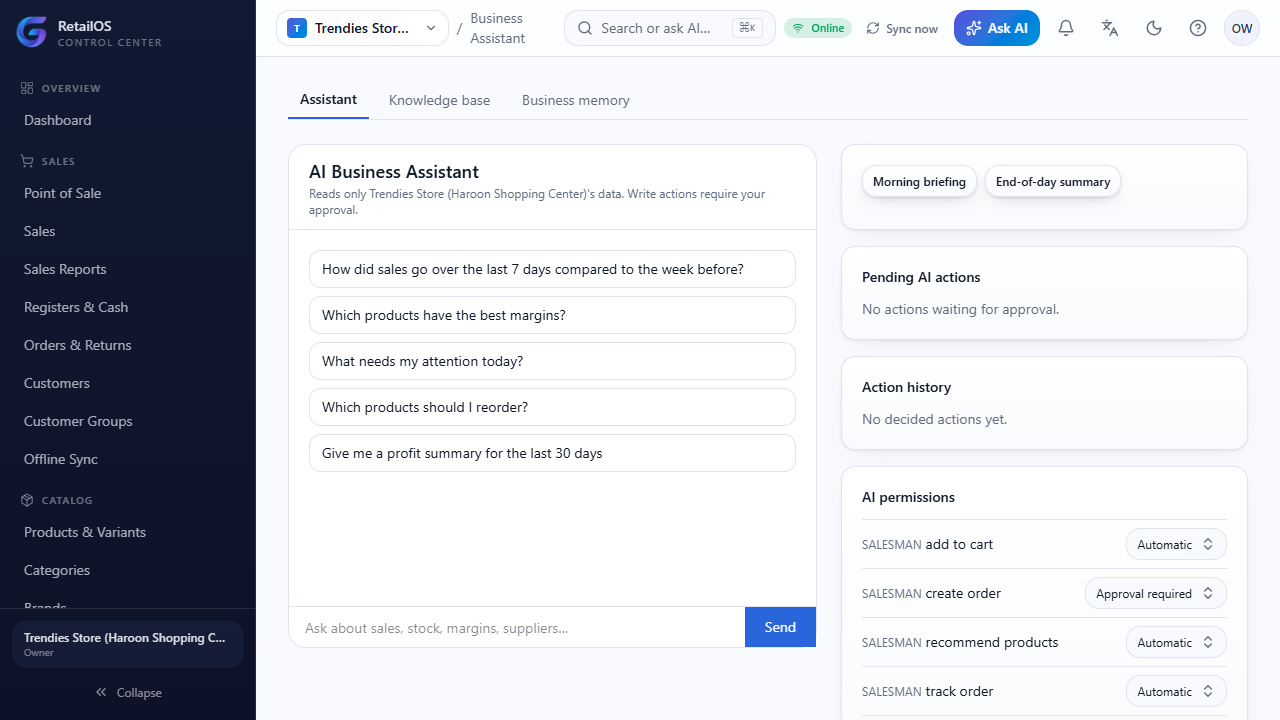
Three tabs: Assistant (chat + right-rail panels: reports, pending actions, action history, permissions, alerts), Knowledge base, Business memory. Most AI writes require owner / admin / manager; chat itself only needs active shop membership.
Assistant chat — /admin/ai (tab: Assistant)
- Backend:
askAssistant(src/lib/ai.functions.ts) →aiChat(agent"assistant") →ai_conversations,ai_messages,ai_tool_calls, may insertai_action_approvals.
| UI label | Field key | Type | Req | Default | Validation / options | Notes |
|---|---|---|---|---|---|---|
| message box | message | text | Yes | "" | 1–2000 chars | Enter to send |
| — | shopId | uuid | auto | current shop | — | — |
| — | conversationId | uuid | auto | null first turn, then returned id | — | threads the conversation |
| — | locale | text | auto | shop.default_locale | ≤5 | — |
Reports: Morning briefing (getBriefing) and End-of-day summary (getEndOfDay), input {shopId} only.
The assistant can take actions, not just answer. Ask it to create a purchase order, adjust inventory, record an expense or payment, or draft a message; it resolves the records it needs (supplier, product, amounts) and then either runs immediately or queues for approval depending on that capability's mode in AI permissions (disabled / approval / automatic). Approval-mode actions appear under Pending AI actions; on Approve the action is actually executed and its result is posted back into the chat (see Permission matrix and Approval queue). Actions never exceed the acting user's role limits.
Permission matrix — /admin/ai ("AI permissions" panel)
- Purpose: Per-capability mode governing whether the AI may act.
- Backend: direct Supabase update on
ai_permissions.mode; server-side action execution re-checkshas_shop_role.
| UI label | Field key | Type | Req | Default | Validation / options | Notes | ||
|---|---|---|---|---|---|---|---|---|
| (agent label) | agent | enum | auto | seeded | ai_agent = salesman \ | assistant | display only | |
| (capability label) | capability | text | auto | seeded | — | display only | ||
| mode dropdown | mode | select | Yes | col default disabled | disabled \ | approval \ | automatic | the only editable field |
| — | id, shop_id | uuid | auto | — | unique (shop_id, agent, capability) | — |
Seeded capabilities (one ai_permissions row per shop): salesman → view_products / view_inventory / view_prices / recommend_products / add_to_cart / track_order (automatic), create_order (approval). assistant → view_sales / view_inventory / view_purchases / view_expenses / view_accounting / view_customers / suggest_reorders / generate_reports (automatic), create_purchase_order / adjust_inventory / record_expense / issue_refund (approval).
Approval queue — /admin/ai (Pending AI actions / Action history)
- Backend: read
ai_action_approvals(limit 30, newest first); decide viadecideAiApproval→ on approve runsexecuteAiAction, writes result back, posts anai_messagessummary.
| UI label | Field key | Type | Req | Default | Validation / options | Notes | |
|---|---|---|---|---|---|---|---|
| Approve / Reject | decision | button | Yes | — | approved \ | rejected | — |
| — | approvalId | uuid | auto | row id | — | — | |
| — | shopId | uuid | auto | current shop | — | — |
Row display fields: action, payload (summarised: supplier, items, total, amount, quantity, variant, reason, note), status (approval_status: pending/approved/rejected/executed, plus app-written failed), created_at, executed_at, result, error, requested_by, decided_by, decided_at, conversation_id.
Alerts — /admin/ai ("Alerts" panel)
- Backend:
listAlerts/refreshAlerts(src/lib/ai-insights.functions.ts) →ai_alerts. Dismiss = direct updateis_read=true. Columns:alert_type,severity(info/warning/critical),title,message,data(JSON),is_read,created_at.
Knowledge base — /admin/ai (tab: Knowledge base)
- Backend:
addKnowledgeDocumentFn/listKnowledgeDocumentsFn/deleteKnowledgeDocumentFn→ai_knowledge_documents(+ chunks intoai_knowledge_chunks).
| UI label | Field key | Type | Req | Default | Validation / options | Notes |
|---|---|---|---|---|---|---|
| Title | title | text | Yes | "" | 1–200; file upload falls back to file.name | — |
| (content) | content | textarea | Yes | "" | 1–200000 | markdown/CSV/plain |
| (file picker) | content (from file) | file | — | — | .txt, .md, .csv read as text | — |
| — | source | text | — | "manual" | ≤100 | not in UI |
| — | docType | text | — | server "text" | col doc_type default policy | not in UI |
| — | is_active | boolean | auto | true | — | — |
content is split by chunkText (~800 chars, 120 overlap) into ai_knowledge_chunks (each with a generated search tsvector). Returns {documentId, chunkCount}. List row shows title, chunk_count (auto), source, created_at.
Business memory — /admin/ai (tab: Business memory)
- Backend:
listBusinessMemoryFn/createBusinessMemoryFn/updateBusinessMemoryFn/setBusinessMemoryActiveFn/decideBusinessMemoryFn(src/lib/ai-memory.functions.ts) →ai_business_memory.
Add memory
| UI label | Field key | Type | Req | Default | Validation / options | Notes |
|---|---|---|---|---|---|---|
| Scope | scope | text | Yes | "" | 1–50; col default general | e.g. policy, supplier, hours |
| (content) | content | textarea | Yes | "" | 1–4000; sanitised (cards/tokens/emails redacted) | — |
| — | source | enum | auto | "user" | — | user-created |
| — | status | enum | auto | "approved" (user) / pending (AI) | — | — |
| — | confidence | numeric | auto | 1 (AI proposals 0.6) | — | — |
| — | is_active | boolean | auto | true | — | — |
Edit id + scope?/content?. Toggle active id + isActive. Decide AI-proposed id + decision (approved\|rejected) — only affects source='ai' AND status='pending'; approve also sets is_active=true. The UI splits into AI-proposed (pending → Approve/Reject) and Approved (Edit / Activate-Deactivate). AI reads (activeBusinessMemory) only include is_active=true AND status='approved'.
AI Connections
- Permissions gate actions: a capability's
modedecides disabled (blocked) / approval (queued intoai_action_approvals) / automatic (executed). Approve re-verifies role + mode server-side beforeexecuteAiAction. - Knowledge → chunks: documents are chunked into
ai_knowledge_chunks, retrieved by shop-scoped full-text to ground chat answers. - Memory needs approval: AI-proposed memory stays pending/inactive until a manager approves.
- Conversations/messages/tool-calls record the chat; approval decisions post follow-up
ai_messages.
Tables owned:
- Storefront:
storefront_settings(uniqueshop_id; live cols +draftjsonb;theme_codedefaultzenis),storefront_themes(global,variantsjsonb, no shop FK),storefront_pages(unique(shop_id, slug)),storefront_sections(is_draft),storefront_navigation(self-FKparent_id;is_draft),storefront_banners(is_draft),storefront_policies(unique(shop_id, policy_type)). Branding/Contact writes targetshops. - AI:
ai_permissions(unique(shop_id, agent, capability);agent=ai_agent),ai_conversations(customer_id→customers),ai_messages(conversation_id→ai_conversations),ai_tool_calls(conversation_id→ai_conversations),ai_action_approvals(conversation_id→ai_conversations;status=approval_status),ai_knowledge_documents,ai_knowledge_chunks(document_id→ai_knowledge_documents; generatedsearchtsvector),ai_alerts,ai_business_memory(scope/source/status/confidence/is_active; RLS owner/admin/manager).
Storefront — Customer Forms
Auth pages (sign in / up / forgot) call Supabase Auth directly from the browser (supabase.auth.*), not a server fn. Cart, wishlist, and compare are client-only, persisted in localStorage (zenis-store:<shopSlug>) via useStorefrontCart (src/lib/cart-store.ts); the DB carts / cart_items / wishlists tables are not written by any storefront route. A customers row is created lazily on first authenticated account/checkout access (getOrCreateCustomer), or by placeOnlineOrder for guests.
Customer sign in — /store/$shopSlug/sign-in
- Purpose: Authenticate a returning shop-scoped customer (password or Google OAuth).
- Access: guest (redirects to
accountif already signed in). - Backend:
supabase.auth.signInWithPassword/ OAuthgoogle/supabase.auth.resend→auth.users.
| UI label | Field key | Type | Req | Default | Validation / options | Notes |
|---|---|---|---|---|---|---|
email | text | Yes | "" | — | — | |
| Password | password | password | Yes | "" | — | — |
| (Continue with Google) | — | button | — | — | OAuth redirect to sign-in | — |
| (Resend confirmation email) | — | button | — | — | shown only when error is "not confirmed" | auth.resend({type:"signup"}) |
Connections — on success navigates to account; session drives getCustomerAccount/checkout prefill; account is scoped per shop (metadata shop_slug).
Customer sign up — /store/$shopSlug/sign-up
- Access: guest. Backend:
supabase.auth.signUp/ OAuthgoogle→auth.users; appcustomersrow created later, lazily.
| UI label | Field key | Type | Req | Default | Validation / options | Notes |
|---|---|---|---|---|---|---|
| Full name | fullName | text | No | "" | → user_metadata.full_name | — |
email | text | Yes | "" | non-empty (trimmed); Supabase email format | — | |
| Password | password | password | Yes | "" | min length 6 (client) | — |
| (shop scope) | shop_slug | auto | auto | shop.slug | — | → user_metadata.shop_slug |
| (Continue with Google) | — | button | — | — | OAuth redirect to origin | — |
Connections — confirmed session → account; later getOrCreateCustomer inserts customers (shop_id, user_id, email). Duplicate-email surfaced as "already exists".
Forgot password — /store/$shopSlug/forgot-password
- Access: guest. Backend:
supabase.auth.resetPasswordForEmail→ email; redirects to shared/reset-password?next=<account>.
| UI label | Field key | Type | Req | Default | Validation / options | Notes |
|---|---|---|---|---|---|---|
email | text | Yes | "" | trimmed | neutral "if that email exists" message |
Product page — add to cart — /store/$shopSlug/product/$slug
- Purpose: Choose a variant + quantity and add to cart (or wishlist/compare).
- Access: guest or signed-in. Backend: none on add (localStorage
addToCart/toggleList); page data viagetStorefrontProduct. No review form exists.
| UI label | Field key | Type | Req | Default | Validation / options | Notes |
|---|---|---|---|---|---|---|
| Options | variantId | select (buttons) | Yes if >1 variant | default variant (is_default) else first active | active variants only | hidden when single variant |
| Quantity | quantity | number | Yes | 1 | min 1; coerced max(1, n) | — |
| Add to cart | — | button | — | — | disabled if no variant or out of stock | writes CartLine to localStorage |
| Wishlist (heart) | — | button | — | — | toggles wishlist list | — |
| Compare | — | button | — | — | toggles compare list | — |
CartLine written per add: variant_id, quantity, name (product + variant), sku, price, image (first product image), product_slug.
Connections — reads Product / active Variant (price, compare_at_price, track_inventory, stock); cart/checkout/wishlist/compare read the same localStorage store; stock drives disabled state.
Cart — /store/$shopSlug/cart
- Access: guest or signed-in (client-side). Backend: none — localStorage. No coupon field.
| UI label | Field key | Type | Req | Default | Validation / options | Notes |
|---|---|---|---|---|---|---|
| Item | name,sku,price | display | — | — | — | read-only |
| Quantity | quantity | number | Yes | current | min 0; <=0 removes line | — |
| Total | — | auto | — | price × quantity | — | computed |
| (trash) | — | button | — | — | removes line | — |
Totals: Subtotal (auto, Σ price×qty client-side); note "Taxes and totals calculated securely at checkout". "Checkout" → checkout, which re-prices server-side.
Checkout — /store/$shopSlug/checkout
- Purpose: Capture contact + address + payment method and place an online order.
- Access: guest or signed-in (prefills name/email from session).
- Backend:
quoteCart(prices, strips cost) andplaceOnlineOrder(src/lib/checkout.functions.ts) → RPCrecord_pos_sale→orders,order_items,payments,receipts, inventory + journal; alsocustomers,ai_alerts.
Contact / Billing details
| UI label | Field key | Type | Req | Default | Validation / options | Notes |
|---|---|---|---|---|---|---|
| Full name | customer.full_name | text | Yes | prefilled from session | 1–120 chars | UI blocks empty name/email |
customer.email | Yes | prefilled from session | valid email | — | ||
| Phone | customer.phone | text | No | "" | max 40 | — |
| — | customer.user_id | uuid | auto | session user id | optional | attaches order to logged-in customer |
Shipping address sub-form (shipping_address, all optional, stored as JSON on order): line1 (max 200), city (max 80), postal_code (max 30), country (max 80).
Payment / meta
| UI label | Field key | Type | Req | Default | Validation / options | Notes | ||
|---|---|---|---|---|---|---|---|---|
| Payment (radio) | payment_method_code | radio | Yes | cod | cod \ | bank \ | card | cod = unpaid/AR (1150); bank/card = prepaid → paid, Bank (1100) |
| — (notes) | notes | text | No | — | max 500 | not in UI (schema-only) | ||
| — (idempotency) | client_uuid | uuid | auto | crypto.randomUUID() | max 80 | dedupes retries via orders.local_uuid | ||
| Items | items[] | auto | Yes | from cart | variant_id uuid, quantity 0.001–9999, min 1 line | server re-prices |
Order summary (auto, from quoteCart): subtotal, tax_total, total, discount_total, and generated order_number / receipt_number.
Connections
- Selects / references: cart line items → Variants; payment method (hardcoded list, not from
payment_methodstable). - Feeds / used by: creates
orders(channelonline, statusconfirmed),order_items,payments(non-COD),receipts, decrements inventory, posts journal,ai_alerts(new_order) — the sameorders/order_itemsthe admin Orders form reads;customersreused or inserted. - Cross-form effects: on success clears cart, navigates to
payment/success?order=<number>; per-IP rate limit (10/min); idempotent onclient_uuid.
Track order — /store/$shopSlug/track-order
- Access: guest (public). Backend:
trackOrder(src/lib/storefront.functions.ts) → readsorders+order_items(contact fields stripped from response).
| UI label | Field key | Type | Req | Default | Validation / options | Notes |
|---|---|---|---|---|---|---|
| Order number | orderNumber | text | Yes | "" | min 1; trimmed | — |
| Email / phone | contact | text | Yes | "" | min 3; must match contact_email or contact_phone | button disabled until both filled |
Returns status/payment/fulfillment/tracking + items + total (read-only).
Account — Profile — /store/$shopSlug/account (tab: Profile)
- Access: signed-in customer. Backend:
updateCustomerProfile(src/lib/customer.functions.ts) →customers.
| UI label | Field key | Type | Req | Default | Validation / options | Notes |
|---|---|---|---|---|---|---|
| Full name | full_name | text | No | customer value | max 120; ""→null | — |
email | No | customer value | max 160; ""→null | — | ||
| Phone | phone | text | No | customer value | max 40; ""→null | — |
Account — Addresses — /store/$shopSlug/account (tab: Addresses)
- Access: signed-in customer. Backend:
upsertCustomerAddress/deleteCustomerAddress/setDefaultCustomerAddress→customer_addresses.
Address sub-form
| UI label | Field key | Type | Req | Default | Validation / options | Notes |
|---|---|---|---|---|---|---|
| — | id | uuid | auto | — | present = update, absent = insert | — |
| Label | label | text | No | "" | max 60 | — |
| Address line 1 | line1 | text | No | "" | max 200 | — |
| Address line 2 | line2 | text | No | "" | max 200 | — |
| City | city | text | No | "" | max 100 | — |
| State | state | text | No | "" | max 100 | — |
| Postal code | postal_code | text | No | "" | max 30 | — |
| Country | country | text | No | "" | max 100 | — |
| Phone | phone | text | No | "" | max 40 | — |
| Set as default | is_default | checkbox | No | false | — | setting true unsets other defaults first |
Connections — saved addresses are the customer's own list (not auto-injected into the checkout form, which has its own inline fields).
Account — Order history / reorder — /store/$shopSlug/account (tab: Orders)
- Access: signed-in customer. Backend:
getCustomerAccount+getOrderDetail→orders,order_items(scoped to owncustomer_id). Reorder is client-side (addToCart).
Read-only list: Order # / Date / Status / Payment / Total (from orders); View opens the detail modal; Reorder these items re-adds each order_item (with variant_id) to the cart.
Wishlist / Compare — /store/$shopSlug/wishlist · /compare
- Access: guest or signed-in (client-side). Backend: none — localStorage
wishlist/comparelists (toggleList,addToCart). DBwishliststable is not used by the storefront. Each item shows storedname/sku/price/imagewith Add-to-cart and Remove buttons; Compare shows a Product / SKU / Price table.
Contact — /store/$shopSlug/contact
- Access: guest. No submit form — display-only contact links (address/phone/email/WhatsApp), directing users to the AI chat button. (
vendor.tsxis likewise a display-only store profile.)
Storefront AI Salesman — chat widget (/store/$shopSlug)
- Purpose: Help shoppers find products and answer store questions from the storefront chat. Read-only for the catalog (no admin data); what it may do is governed by the salesman rows in AI permissions.
- Backend:
askStorefrontAssistant→aiChat(agent"salesman", tools insrc/lib/ai.server.ts).
It can now:
- Search / recommend by price, category or what's on sale — e.g. "bags under 1600", "show me jackets", "what's on sale" (
max_price, category andon_salefilters), returning live stock and discount info. - Surface product reviews — published customer reviews and the average rating for a product (via
product_reviews), e.g. when a shopper asks whether an item is any good. - Answer store questions — accepted payment methods, the list of available categories, contact details, business hours and policies (returns / shipping / privacy / terms / FAQ) via
store_info.
Tables owned: customers (shop_id→shops, user_id→auth.users, unique (shop_id,user_id)), customer_addresses (customer_id→customers), orders (customer_id→customers, unique (shop_id,order_number), partial-unique (shop_id,local_uuid)), order_items (order_id→orders, variant_id→product_variants), payments (order_id→orders), receipts (order_id→orders, unique (shop_id,receipt_number)). Defined but unused by these storefront routes (client-side localStorage instead): carts, cart_items, wishlists. Checkout payment methods are hardcoded (cod/bank/card), not from payment_methods. The storefront product page has a verified-buyer review submission form (the shopper supplies their order number, which must contain the product); submissions land as pending and appear on the storefront only after a manager publishes them from /admin/reviews. The AI Salesman surfaces the published rows from the reviews table.
Reports
Three read-only report suites, each built the same way: a report picker, a From / To date range, and Print + Download CSV actions (ReportShell; default range = month-to-date). Because they expose cost, margin and outstanding balances, each suite is role-gated. All three read from existing sales / purchasing / inventory data (orders, POs, receipts, movements, balances, ledger) — no new tables; each report exports CSV with the columns shown on screen.
Sales Reports — /admin/sales-reports
- Access: FINANCE_ROLES —
owner,admin,manager,accountant. - Reports: Summary · By day · By product · By category · By brand · By payment · By channel · By cashier · By register · By branch · Tax · Returns. The product/category/brand reports show units, revenue, cost, margin and margin %.
Purchase Reports — /admin/purchasing-reports
- Access:
owner,admin,manager,accountant,inventory. - Reports: PO status · Supplier spend · By product · Goods receipts · Outstanding POs · AP ageing · Cost history.
Inventory Reports — /admin/inventory-reports
- Access:
owner,admin,manager,inventory,accountant. - Reports: Valuation · By location · Low stock · Dead stock · Movements · Adjustments · Turnover.
Promotions, Loyalty & Marketing
Promotion / coupon — /admin/promotions
- Purpose: A unified, server-authoritative discount model. Promotions define the discount; coupons wrap a promotion with a code and usage limits. Validation and discount computation always run on the server, so the same rule applies identically across POS, online checkout and Restaurant.
- Access: MANAGERS (
owner/admin/manager); modulemarketing. Backend:marketing.functions.ts→marketing.server.ts. Tabs: Promotions & coupons (sub-tabs promotions / coupons) and Free gifts.
New promotion
| UI label | Type | Req | Default | Notes |
|---|---|---|---|---|
| Name | text | Yes | "" | shown on the discount line |
| Type | select | Yes | Percentage | percentage or fixed-amount |
| Percent (0–100) | number | Yes (percentage) | 0 | discount rate |
| Minimum order | number | No | 0 | only applies at/above this subtotal |
| Max discount (cap, optional) | number | No | — | caps the computed discount |
| Channels | multi-toggle | No | empty = all | pos / online / restaurant |
| Active | toggle | Yes | on | inactive promotions never apply |
Coupon — wraps a promotion with a code customers enter plus usage limits; remaining-use and eligibility checks are enforced server-side at checkout.
Free-gift campaign — /admin/promotions (tab: Free gifts)
- Purpose: "Buy X, get Y free" rules. When the cart qualifies (spend threshold or trigger products), eligible gift products are offered; the chosen gift is added at unit price 0 while its real unit cost still flows to COGS. Entitlement and gift validation run on the server.
- Access: MANAGERS; module
ecommerce. Backend:free-gift.functions.ts/free-gift-admin.server.ts. Storefront shows a gift picker at checkout; POS applies eligible gifts on the ticket.
Product reviews & moderation — /admin/reviews
- Purpose: Verified-purchase product reviews. A shopper submits one from the storefront product page ("Write a review") — the form asks for a rating, order number, name, title and review and is only accepted if that order actually contains the product (verified buyer), so reviews can't be faked. Submissions land as
pending("your review… will appear once the shop approves it"). - Access: MANAGERS (
owner/admin/manager) to moderate; moduleecommerce. Backend:reviews.functions.ts(submitReview,getProductReviews,listReviewsForModeration,moderateReview). - Moderate: the page has Pending / Published / Rejected tabs and an Export CSV. Each row shows the product, rating, title/body and author with Publish / Reject actions. Publishing makes the review and its star rating appear on the storefront product page and feed the AI Salesman's "is this any good?" answers; only published reviews are ever public (anyone may read
status = 'published'; members read all for moderation). Rejecting keeps it hidden.
Loyalty program — /admin/loyalty
- Purpose: One loyalty engine shared by Retail POS, Restaurant and Ecommerce. Points derive from real sales through an idempotent ledger; balances are never a mutable number.
- Access: MANAGERS to manage the program (some lifecycle actions are
owner/adminonly); moduleloyalty.
Program
| UI label | Type | Default | Notes |
|---|---|---|---|
| Program enabled | toggle | off | master switch |
| Program name | text | "Loyalty" | shown to customers |
| Tier basis | select | Lifetime spend | how tiers are earned |
| Points earned per 1 spent | number | 1 | earn rate |
| Points to redeem 1 value | number | 100 | redemption rate |
| Minimum redemption (points) | number | 100 | floor to redeem |
| Max redemption (% of order) | number | 50 | caps redemption per order |
| Earn points on tax | checkbox | off | include tax in the earning base |
| Rounding | select | Floor | how fractional points round |
Tiers (optional, each with an earning multiplier), Rewards (redeemable; discount rewards reuse the checkout discount mechanism), Point expiration policy (FIFO, disabled by default; redeemed points are never removed; points before the effective date are grandfathered), Tier lifecycle (Process tier transitions — idempotent; unchanged tiers create no history), and a Reward claims list.
Earning & redeeming (in practice): points are earned automatically when a sale completes with a customer attached — at the POS terminal (tap Customer and pick the shopper before taking payment), in Restaurant, or at online checkout — on the earning base (subtotal, or including tax if Earn points on tax is on); the running balance appears on the customer's 360 profile. Redemption is done at the storefront (online) checkout, where a signed-in customer applies a configured Reward (a points-cost discount that reuses the checkout discount mechanism, within Minimum redemption and Max redemption % of order). The Retail POS terminal earns points but does not itself expose reward redemption.
Marketing campaign — /admin/campaigns
- Purpose: Target a dynamic segment or static audience over a channel adapter. Delivery is DEMO until an external provider is configured; recipient audiences are snapshotted at send time and consent is enforced.
- Access: MANAGERS; module
marketing. Related: the social calendar below.
Social calendar — /admin/social
- Purpose: Plan and schedule social posts on a content calendar. New post sets a Channel (e.g. Facebook), a Scheduled time and a Caption, then Save adds it to the calendar as a draft. Demo publish marks the post "demo published" — real publishing is DEMO-only until a social provider is connected (the calendar clearly distinguishes demo/preview from real publishing; provider credentials are required to post for real).
- Access: MANAGERS; module
marketing.
Manufacturing (BOM & costing)
Bill of materials — /admin/manufacturing (tab: BOMs & costing)
- Purpose: Define what it takes to make each manufactured product, then see its theoretical cost & margin. One active BOM per finished variant; superseding a BOM keeps the older version as history.
- Access: INVENTORY_ROLES (
owner/admin/manager/inventory); moduleinventory. Backend:manufacturing.functions.ts→manufacturing.server.ts; reusesvariant_costs.avg_costand the shared unit-conversion helper.
New BOM — set BOM name, choose the finished product/variant, Output quantity (units yielded per batch), Version, optional Notes and an Active toggle (the current recipe). Save the BOM first, then add components. Add component lines:
| UI label | Type | Req | Notes |
|---|---|---|---|
| Component | variant select | Yes | the material/ingredient consumed (multi-select picker with search / category / brand / in-stock filters) |
| Quantity | number | Yes | per one finished unit |
| Unit (UoM) | text | No | defaults to the component's stock unit; converted via unit-conversion |
| Type | select | No | Material / Packaging (classifies the cost bucket) |
| Wastage % | number | No | scrap allowance folded into the rolled-up cost |
An Additional costs row adds Labor / Overhead (label + amount). The Theoretical cost panel then shows, per batch: Materials, Packaging, Additional, Total (batch), Unit cost (rolled up from each component's avg_cost × qty, unit-converted, + wastage), the finished variant's Selling price, Gross margin and Margin %. A note flags when any component has no cost / an unsupported unit (the total is then a floor). A newly created BOM persists as inactive until you toggle Active and save.
Production planning — /admin/manufacturing (tab: Production planning)
- Purpose: Plan production runs against BOMs and preview requirements & cost. Pick a BOM + Produce (units) → Calculate shows the Unit cost, Estimated batch cost (unit cost × units) and a per-component table of Required / Available / Shortage / Status (OK or short). Production inventory posting is deferred — planning does not consume components or add finished goods to stock ("No inventory is changed" — no stock or GL writes).
Restaurant
Enabled by the three Restaurant modules (Restaurant POS, Restaurant Tables, Restaurant Kitchen). Management screens are gated to MANAGERS (owner / admin / manager); customer-facing ordering surfaces are separate. Backend: restaurant*.functions.ts (setup rendered by RestaurantPanel.tsx).
Overview — /admin/restaurant
- Purpose: Operational pulse — cards for Reservations today, Waiting now, Kitchen tickets pending and Food cost, plus quick links to Restaurant POS, Delivery, Refunds and Floor & Tables.
Setup — /admin/restaurant/<section> (tabbed)
One page with tabs Floor & Tables, Menu & Modifiers, Kitchen Setup, Recipes, Settings (URL section = tables / menu / kitchen / recipes / settings). A branch filter scopes everything.
Restaurant Website — /admin/restaurant-site
- Purpose: A public restaurant site for your customers — menu showcase, opening info, promotions — separate from your online store and from table-QR ordering. It lives at
/store/<your-store>/dine, and at the root of any custom domain you point at it (below). Nothing is public until you flip Publish. - Backend:
shop-site.functions.ts→shop_site_settings/shop_site_banners/shop_site_navigation/shop_site_pages(persite_key, hererestaurant). Writes require owner/admin/manager via the Restaurant module's guard; every change is audited (shop_site.*). - Publish — on/off switch. Off = a plain "not available" page (hidden from search engines); your store is never affected either way.
- Branding & hero — primary/accent colours (
#rrggbb; leave empty to inherit your storefront theme), announcement bar text, hero headline/subheadline, hero image (upload, or paste an https URL), hero button label + link, SEO title/description, social links. - Banners — promo cards under the hero: title, subtitle, image (upload/URL), optional link, position, visible toggle.
- Navigation links — header links replace the automatic ones (Menu + your pages); footer links list under Links. Label + URL + position + visible.
- Pages — simple text pages at
/dine/p/<slug>(e.g.opening-hours): slug, title, content (plain text; a blank line starts a new paragraph), published toggle. - The menu is live — it shows exactly what you curate in Restaurant → Kitchen Setup (
restaurant_menu_items): names, photos, prices and today's availability. There is nothing to duplicate here. - Own domain: Storefront → Domains → add/verify the hostname as usual, then set its Serves selector to Restaurant website. That domain then opens the restaurant site at
/(your store keeps its own domain). See the Domains section below.
Floor & Tables
| Form | Fields |
|---|---|
| Floor | Name (e.g. "Ground Floor"), active, branch |
| Table | Code (e.g. "T01"), Name (optional), Capacity (default 4), Floor, branch, active |
Menu & Modifiers
| Form | Fields |
|---|---|
| Modifier group | Name (e.g. "Add-ons"), selection type (single / multiple), required, min / max selections |
| Modifier option | Name (e.g. "Extra Cheese"), price adjustment |
| Assign to product | pick a Product, then attach modifier group(s) |
Kitchen Setup — define kitchen stations (Code, e.g. "KITCHEN") and route each product → station with an optional prep time (drives KOT routing on the KDS). Routing a product here (with Available on) is also what publishes it to the customer online-ordering menu — the public /order/$token storefront lists exactly these curated items (restaurant_menu_items), not the whole catalog, so add every online-orderable item here.
Recipes — for a menu product, list ingredient products with quantity + unit of measure; feeds theoretical food cost.
Settings — enable Public (online) ordering, toggle Pickup and/or Delivery fulfilment, and publish the customer ordering link / QR (/order/$token). Save to apply the fulfilment toggles. See Online ordering (customer) below.
Restaurant POS — /admin/restaurant-pos
- Purpose: Dine-in / takeaway / delivery ordering against floors, tables and table sessions; sends items to the kitchen (KOT) and settles like the retail POS. Requires the Restaurant POS module.
- Menu source: the product catalog — every active product is a menu tile (searchable, filtered by category); tiles can carry modifier groups (see Menu & Modifiers).
- Flow (dine-in): tap a table → Open table (Guests, optional Waiter) → a running order (
RO-…) opens with a live timer → tap tiles to add lines (each tap adds a line; qty ±, Remove before sending) → Send KOT fires it to the kitchen (lines flip to sent; only Void/Comp afterwards) → Request bill / Settle. Merge / Split combine or divide orders; Recover restores a cleared cart; Cancel voids the session. - Tax applies from the shop's active tax rate (e.g. 17% VAT) on the running order and the settle total.
- Settle — pick a payment method and confirm the tendered amount → posts the sale exactly like the retail POS: a balanced journal (Dr Cash/Bank · Cr Sales Revenue · Cr Tax Payable, plus Dr COGS · Cr Inventory), decrements stock, and frees the table back to available.
Kitchen Display (KDS) — /admin/restaurant/kds
- Purpose: Live kitchen queue fed by the KOT stream; screens refresh automatically (real-time). Requires the Restaurant Kitchen module.
- Board: each ticket shows its order (
RO-…), table, items and age, grouped by station (All stations or per station), with header counters Active / Rush / Late / Served / Bumped; Active / Board / History views plus Compact and Fullscreen modes. - Actions: Bump (mark done — moves the ticket to the Bumped — recall strip where Recall returns it; the order/payment state is untouched), Rush (priority) and Served (delivered to table).
Front-of-house & operations sub-pages
- Reservations —
/admin/restaurant/reservations(bookings: guest, phone, party size, date & time, duration, optional table, special requests). Statuses pending → confirmed → seated → completed / cancelled / no-show; Seat picks a table + optional waiter and opens a dine-in order through the restaurant engine (the table flips to occupied). - Waitlist —
/admin/restaurant/waitlist(walk-in queue: guest, phone, party size, quoted wait). Notify tells the guest their table is ready (waiting → notified); Seat opens a dine-in order on a chosen table; Remove drops them. - Delivery —
/admin/restaurant/delivery: New delivery captures the customer (name, phone, address, delivery fee, notes) and opens a restaurant order — add items in Restaurant POS, Send KOT and Settle (the same order→KOT→settlement engine as dine-in). Track the lifecycle new → accepted → preparing → ready → out for delivery → delivered with the per-order advance button. Operational last-mile assignment / dispatch / ETA lives on/admin/restaurant/fulfillment(Active / Exceptions / History / External Orders) and never changes the order, payment, settlement or inventory. - Online ordering (customer) —
/order/$token: the branded self-service storefront customers reach from the Public Ordering link / QR (enable it under Settings, above). It renders a themed hero with the enabled Pickup / Delivery modes, menu categories, featured + full menu (with search + category filter), and the shop's contact details + opening hours. *The menu lists only the items you curated in Kitchen Setup (product routing / availability →restaurant_menu_items), not the full catalog — if it shows “No items found”, no items have been curated yet. Customers add items to a cart, choose Pickup or Delivery (name / phone / address), and place the order, which lands as a restaurant order (RO-…) in the same order → KOT → settle engine. New online orders surface in Restaurant POS → Takeaway orders (status received*) to accept → send KOT → settle, with tax applied to the order total. Tiles show “Only N left” / “Unavailable” from server-authoritative stock. - Refunds —
/admin/restaurant/refunds: refund a settled restaurant order — pick per-line quantities to refund (full or partial), a refund method and a reason. Reuses the shared return/refund engine (reversing journal + loyalty reversal), with no restock of prepared food by default; the server re-validates refundable quantities to prevent over-refund and produces aRET-…return. - Wastage —
/admin/restaurant/wastage(record why restaurant stock was lost). Two-step: Record Waste (search item, qty in stock unit, stock location, reason SPOILAGE / EXPIRED / DAMAGED / …, notes) creates a draft with a deterministic cost snapshot but no stock move; post it from Open / Failed to decrement stock through the Inventory writer (it never posts Accounting). Feeds Food cost. - Food cost —
/admin/restaurant/food-cost(recipe-driven cost vs price). - Analytics —
/admin/restaurant/analytics(restaurant performance).
CRM, Segments & Analytics
One shared customer identity across POS, Restaurant, Ecommerce, CRM, Loyalty and Marketing — customers are never duplicated. Module crm; reads open to SELLING_ROLES, management to MANAGERS. (Loyalty is documented above under Promotions, Loyalty & Marketing.)
Customer Directory — /admin/crm
- Purpose: Server-side searchable directory of every customer with a 360° profile. Search by name / phone / email / code / company; filter by status, tag, segment and consent. Opening a customer shows their contact, tags/segments, order history & spend, loyalty and activity timeline — the same record used by POS, checkout and Loyalty.
- Access: SELLING_ROLES read; MANAGERS manage.
- Editable customer record (via Edit here or on
/admin/customers; owner / admin / manager):
| UI label | Field key | Type | Notes |
|---|---|---|---|
| Name | full_name | text | ≤ 120 chars |
| Phone | phone | text | ≤ 40 chars |
email | text | ≤ 160 chars | |
| City | city | text | ≤ 80 chars |
| Group | group_id | select | customer group → group pricing in POS/checkout |
| Tags | tags[] | tags | ≤ 30 tags, ≤ 40 chars each |
| Notes | notes | textarea | ≤ 1000 chars |
Much of the profile (orders, spend, segment, last-order date, loyalty points) is derived from real orders — the customer record is created automatically at first purchase (name/phone/email) and enriched here.
Segments — /admin/segments
- Purpose: Define customer segments (rules over spend / recency / tags) reused by Marketing campaigns and directory filters.
CRM Analytics — /admin/crm-analytics
- Purpose: Read-only customer analytics (acquisition, retention, RFM-style views) derived from real orders.
Growth Dashboard — /admin/growth
- Purpose: Marketing/growth overview across campaigns, segments and customer growth.
HR & Payroll
Module employees for HR (MANAGERS); Payroll is finance-gated (owner / admin / accountant).
Employees — /admin/employees
- Purpose: Team directory. An employee is an HR record and may or may not have an application login. Create with First/Last name (plus optional photo, gender, nationality, and the Employment / Organization / Contact / Sensitive / Payment tabs); code auto-assigns
EMP-####. The saved profile has tabs Overview, Employment, Contact, Attendance, Leave, Payroll, Documents, Compliance, Lifecycle, Emergency, History, Payment. - Access: MANAGERS.
Departments / Designations — /admin/departments, /admin/designations
- Purpose: HR/org master data referenced by employees.
Attendance — /admin/attendance
- Purpose: Daily attendance register; feeds payroll. Calculations are server-authoritative.
- Views: Daily (per-day register, filterable by department / branch) and Register (range). Header counters: Present / Late / Absent / Half day / On leave / Day off / Holiday.
- Mark attendance — Add an employee to today… → pick employee → set Status (Present / Late / Absent / Half day / On leave / Day off / Holiday), Check in & Check out times and optional Notes. The server computes Worked hours (e.g. 09:00 → 17:30 = 8h 30m) and rolls an overnight check-out past midnight to the next day automatically. Mark on a row re-marks (correction). Approved leave (below) auto-fills those days as On leave.
Leave — /admin/leave
- Purpose: Leave types, per-employee balances and requests → approvals. Approved leave flows into attendance automatically.
- Leave Types tab — Code, Name, Default days / year (a reference figure — it is not auto-accrued into balances; grant entitlements on the Balances tab), Paid leave, Requires approval, Carry forward allowed.
- Requests tab — New request: Employee, Leave type, Day part (full / half — half only for single-day requests), Start / End date (days counted inclusively), Reason → Submit (
pending) → Approve / Reject. Status filter: All / Pending / Approved / Rejected / Cancelled; an approved request can still be Cancelled. - Balances tab — pick an employee + year: columns Opening / Accrued / Adjusted / Used / Remaining, where Remaining = opening + accrued + adjusted − used and Used is driven by approved leave (not editable here). Adjust balance sets the opening / accrued / adjusted figures per leave type (this is how annual entitlements are granted).
Shifts — /admin/shifts
- Purpose: Shift schedules and assignments.
Recruitment — /admin/recruitment
- Purpose: Hiring pipeline (candidates through stages).
Loans — /admin/loans
- Purpose: Employee loans / advances and repayment schedules.
Performance — /admin/performance
- Purpose: Performance reviews.
Employee Lifecycle — /admin/hr/lifecycle
- Purpose: Track and action employment-change workflows — Probation Review, Confirmation, Transfer, Promotion, Salary Revision and Contract Renewal. The dashboard surfaces counters (probation ending ≤30 days; reviews / confirmations / transfers / promotions / salary-revisions pending; contract renewals due; awaiting application) and a list of actions filterable by type and status (
draft → submitted → approved → rejected → completed / cancelled). Individual actions are raised per employee (from the profile's Lifecycle tab → New lifecycle action: pick Type, Effective date and Reason, then the action's target chosen by name from a dropdown — Promotion → New designation, Transfer → Target department / branch, Salary Revision → New amount — never a raw id/uuid box) → Create draft. Submitting, approving and completing one then applies the change through the authoritative HR path (updating the employee's designation/department/salary), and every step lands on the employee's Unified timeline.
Workforce Requests — /admin/hr/workforce-requests
- Purpose: A manager approval inbox for employee-raised attendance corrections and loan / advance requests, plus a leave Calendar and leave Carry Forward. Approve authorizes a request and Apply routes it through the existing attendance / loan writers; managers see only their direct reports. Carry Forward rolls eligible remaining leave balance from a source year into a target year (types with carry-forward enabled) — idempotent (re-running never double-counts), with a Preview before you Run.
Payroll — /admin/payroll
- Purpose: Calculate, review, approve, post to the ledger and pay salaries. Tabs: Payroll Runs, Salary Structures, Pay Components, Settings.
- Access:
owner/admin/accountant.
1. Settings (one-time, required before posting) — map the ledger accounts payroll uses: Salary / earnings expense account (fallback, e.g. 6100 Salaries), Employee payable account (required to post/pay — a liability, e.g. 2000 Accounts Payable), optional Deduction liability account, plus default working days/month, hours/day and overtime multiplier. Pay components can override the expense account per component.
2. Salary structure (Salary Structures tab) — pick an employee → New structure: Effective from (structures are dated; a new one closes the previous period and preserves history), Base salary, optional Currency, Std days / month (26), Std hours / day (8), and optional allowance / deduction components (drawn from Pay Components). Base-salary-only is valid.
3. Period → run → calculate → approve → post → pay
| Step | What happens |
|---|---|
| New period | e.g. "September 2026" with start / end / payment dates → status open |
| New run | names a run for the period (optionally scoped by department / branch) → draft |
| Calculate | builds each employee's payslip from their structure & attendance; prorates for partial-period employment (a mid-period joiner is paid only for days employed) and raises warnings (e.g. no shift assignment, proration) → calculated |
| Approve | confirms the run (if any employee has warnings, a "Approve anyway?" prompt appears) → approved |
| Post to accounting | posts one balanced journal (Dr salary/earnings expense · Cr employee payable + deduction liabilities), period-guarded → posted. Editing after calculate requires Reopen → Recalculate so the lines re-snapshot the current account mappings. |
| Pay | per employee (Details → Salary payment): record the net against Cash or Bank → payment status paid (Dr employee payable · Cr Cash/Bank). A default Cash Drawer and Bank Account are provisioned automatically (linked to Chart-of-Accounts Cash 1000 / Bank 1100), so cash payouts work out of the box; older shops are back-filled on their first payout |
Employee Details shows attendance stats, the component breakdown, any warnings, a View payslip (PDF — never license-gated) button, and an Add manual adjustment (earning/deduction) control.
- Related:
/admin/hr/payroll-ops(payroll reports & reversal).
Business Intelligence
Executive Dashboard — /admin/bi
- Purpose: A unified, read-only executive view over existing GoRetailOS reporting. Figures are UTC-bucketed (operational sales and Accounting P&L are separate lenses). Pick a From / To range and a Compare basis (previous period / yesterday / same weekday last week / previous week / previous month / same month last year / none).
- Access: role-gated (managers / finance).
Reports Center — /admin/bi/reports
- Purpose: A registry of read-only BI reports; open any report over a date range and Export (server-built CSV). Each report is visible only when its module and your role allow it. Backend:
bi-report-registry.ts(BI_REPORTS) →bi-reports.server.ts. - Reports (by category):
- Sales performance — Sales Overview, Sales by Product, Sales by Staff, Consolidated Sales
- Tax — Sales Tax; Returns — Sales Returns
- Valuation — Inventory Valuation, Inventory by Location; Stock health — Low Stock, Dead Stock; Movements — Stock Movements, Stock Adjustments
- Financial statements — Profit & Loss, Balance Sheet, Cash Flow, Trial Balance; Receivables & Payables — AR Ageing, AP Ageing
- Purchase orders — Purchase Order Status, Purchases by Product, Goods Receipts, Outstanding Purchase Orders; Supplier analysis — Supplier Spend
- Customer analytics — Customer Analytics; Menu — Menu Performance; Labour cost — Payroll Cost
Advanced Procurement
A sourcing pipeline in front of Purchasing: internal requisitions → approval → RFQ to suppliers → quotations → comparison → award → optional contract → convert to a purchase order. Module procurement; access via procurement permissions (owner/admin allow-all, otherwise per-role role_permissions with built-in defaults). Hub at /admin/procurement (requisition / sourcing / governance / vendor-portal KPIs). Backend: procurement.server.ts (requisitions), procurement2.server.ts (RFQ + awards), procurement3.server.ts (contracts).
Requisition — /admin/procurement/requisitions
- Purpose: Raise an internal purchase request; submit for approval, then it is decided (approved / rejected) per the approval policy. Numbered
REQ-####.
| UI label | Field key | Req | Notes |
|---|---|---|---|
| Branch | branch_id | No | scopes the request |
| Department | department_id | No | cost owner |
| Required date | required_date | No | when it's needed |
| Priority | priority | No | low / normal / high / urgent |
| Justification | justification | No | why it's needed |
| Budget reference | budget_reference | No | links to a budget line |
| Notes | notes | No | — |
| Items | items[] | Yes | each: variant/description, quantity, unit, estimated price |
RFQ — /admin/procurement/rfqs
- Purpose: Invite selected suppliers to quote (optionally created from a requisition). Numbered
RFQ-####.
| UI label | Field key | Req | Notes |
|---|---|---|---|
| Title | title | Yes | — |
| Description | description | No | — |
| Issue date / Response deadline | issue_date / response_deadline | No | deadline drives "awaiting responses" |
| Expected delivery / location | expected_delivery_date / delivery_location | No | — |
| Payment terms / Terms | payment_terms / terms | No | — |
| Suppliers | supplier_ids[] | No | who to invite (also via the vendor portal) |
| Items | items[] | Yes | lines to be quoted |
Quotations & comparison — /admin/procurement/quotations, /admin/procurement/comparisons
- Purpose: Record or receive supplier quotations against an RFQ (vendor-portal submissions land here), then compare them side-by-side to pick the best.
Award — /admin/procurement/awards
- Purpose: Award the RFQ to a supplier/quote; add charges to reach the award total, then convert to a PO.
| UI label | Field key | Req | Notes |
|---|---|---|---|
| Supplier | supplier_id | Yes | winning supplier |
| RFQ / Quote | rfq_id / quote_id | No | source |
| Payment / Delivery terms | payment_terms / delivery_terms | No | — |
| Freight / Other / Tax / Discount | freight_amount / other_charges / tax_amount / discount_amount | No | roll into the award total |
| Items | items[] | Yes | awarded lines |
Contract — /admin/procurement/contracts
- Purpose: A governing agreement with a supplier (often from an award); tracks value, dates and expiry. Expiry status derives from
end_date(active → expiring within 60 days → expired).
| UI label | Field key | Req | Notes |
|---|---|---|---|
| Supplier / Title | supplier_id / title | Yes | — |
| Contract type | contract_type | No | — |
| Start / End / Renewal date | start_date / end_date / renewal_date | No | end_date drives expiry status |
| Contract value | contract_value | No | — |
| Owner | owner_user_id | No | responsible person |
| Items | items[] | No | each: description, agreed price, unit, quantity ceiling, minimum commitment, discount, valid-until |
Approval inbox / Suppliers / Reports / Settings
- Approval inbox —
/admin/procurement/approvals(pending requisition/award approvals for the signed-in approver). - Suppliers —
/admin/procurement/suppliers(supplier records with a vendor-portal invite). - Reports —
/admin/procurement/reports(sourcing analytics). - Settings —
/admin/procurement/settings: approval policy — require approval, approval threshold, approver roles, requisition prefix.
Vendor portal (supplier-facing) — /store/$shopSlug/vendor + /vendor.invite.$token + /vendor.rfq
- Purpose: Invited suppliers open their RFQ via a tokened link and submit a quotation that lands in Quotations — no admin login required.
Appendix A — Enumerations
Many forms share these fixed choice lists (defined as Postgres enum types). Where a form has a "status" or "type" select, it almost always draws from one of these:
| Enum | Used by | Values |
|---|---|---|
shop_role | Team & Roles, invitations | owner · admin · manager · cashier · accountant · inventory · staff |
product_status | Product | draft · active · archived |
order_status | Orders | pending · confirmed · processing · completed · cancelled · refunded |
order_channel | Orders | pos · online · ai |
payment_status | Orders, invoices | unpaid · partial · paid · refunded |
fulfillment_status | Orders | unfulfilled · processing · shipped · delivered · picked_up · returned |
movement_type | Inventory movements | opening · purchase · sale · return · adjustment · transfer_in · transfer_out · count |
transfer_status | Transfers | draft · requested · approved · shipped · received · cancelled |
po_status | Purchase orders | draft · submitted · approved · partial · received · cancelled |
account_type | Chart of accounts | asset · liability · equity · income · expense |
approval_status | AI action approvals | pending · approved · rejected · executed |
ai_agent | AI | salesman (storefront) · assistant (admin) |
Appendix B — Tables ↔ forms index
The database has ~75 tables, all scoped by shop_id. Key foreign keys (the wiring behind the "Connections" blocks):
| Pointer field | Points at | Meaning |
|---|---|---|
shop_id | shops | tenant scope on every table |
branch_id | branches | branch binding |
category_id | categories / expense_categories | product category · expense category |
parent_id | categories / accounts / storefront_navigation | tree self-reference |
brand_id | brands | product brand |
tax_rate_id | tax_rates | product/line tax |
product_id | products | variant/image parent |
variant_id | product_variants | the sellable unit on order/PO/cart/count/transfer/return lines |
customer_id | customers | order/cart owner |
order_id / order_item_id | orders / order_items | sale + returned line |
return_id | returns | refund parent |
register_id | registers | POS till |
cash_session_id | cash_sessions | open till session |
location_id / from_location_id / to_location_id | inventory_locations | stock location(s) |
transfer_id | inventory_transfers | transfer lines |
stock_count_id | stock_counts | count lines |
supplier_id | suppliers | PO / invoice / payment |
purchase_order_id | purchase_orders | receipt/invoice source |
goods_receipt_id | goods_receipts | receipt lines |
supplier_invoice_id | supplier_invoices | supplier payment target |
account_id | accounts | journal line / expense account |
journal_entry_id | journal_entries | ledger lines |
document_id | ai_knowledge_documents | knowledge chunks |
conversation_id | ai_conversations | AI messages |
Per-domain table ownership is listed at the end of each section above.